Last Updated: October 23, 2026
Quick Summary
Most furnace breakdowns trace back to a single failed part, so furnace repair costs far less than a new system and is often the right call. Use the 50% rule: if the repair costs less than half a new furnace and the unit is otherwise sound, repair it.
- A gas furnace typically lasts 15 to 20 years with regular maintenance, and age alone is not a verdict.
- Igniter replacement runs roughly $150 to $400, while blower motor replacement runs roughly $400 to $1,200.
- A cracked heat exchanger is the one finding that shifts the decision toward replacement for safety.
- A diagnostic visit should end with a named failed part and a written repair estimate.
- Ask what failed, what the repair costs, and whether the rest of the system is sound.
Table of Contents
- Why Furnace Repair Often Beats Replacement
- Signs a Furnace Needs Repair (Not Replacement)
- Furnace Life Expectancy: Age Alone Is Not a Verdict
- Furnace Repair Cost vs. Replacement Cost: Weighing the Numbers
- When Furnace Heat Exchanger Replacement Changes the Decision
- How to Evaluate a Replacement Recommendation Before You Agree
- A Step-by-Step Decision Framework for Repair vs. Replacement
- Frequently Asked Questions
Why Furnace Repair Often Beats Replacement
A furnace that quits on a cold night does not automatically need to be replaced. Most breakdowns trace back to a single failed part, and a furnace repair costs far less than a new system. Age alone rarely decides the question.
Here is the tension most homeowners miss. A replacement quote feels safer. It is also the most expensive option on the table, and it is often the wrong one.
Below, we walk through a decision framework you can apply before you sign anything, plus the specific faults that almost never justify a new system.
The 50% Rule and How to Apply It
The 50% rule is a common industry guideline: if a repair costs more than half the price of a new furnace, replacement deserves serious consideration. It is a starting point, not a verdict.
Apply it with care. A repair quote that lands near that threshold usually means a major component failed, such as a blower motor or a control board. In that case, ask what else is aging. If the heat exchanger is sound and the unit has years left, the repair still wins.
Repairable Faults That Do Not Require a New System
Most no-heat calls end with a part swap, not a truck dropping off a new furnace. These faults are routine and repairable:
- Ignition system failure. A bad igniter or flame sensor stops the burners from lighting.
- Blower motor trouble. A failing motor causes weak airflow or no airflow at all.
- Thermostat faults. A miswired or dead thermostat mimics a dead furnace.
- Clogged filter or blocked ductwork. Restricted airflow causes overheating and short cycling.
- Dirty flame sensor. A common cause of repeated shutdowns within seconds of ignition.
A common mistake is approving a replacement before anyone has tested these parts. A proper diagnosis finds the actual failed component first.
Signs a Furnace Needs Repair (Not Replacement)
The clearest signs a furnace needs repair are short cycling, uneven heating, strange noises, and rising energy bills. Each points to a fixable component, not a dead system. Treat these as repair signals until a technician proves otherwise.
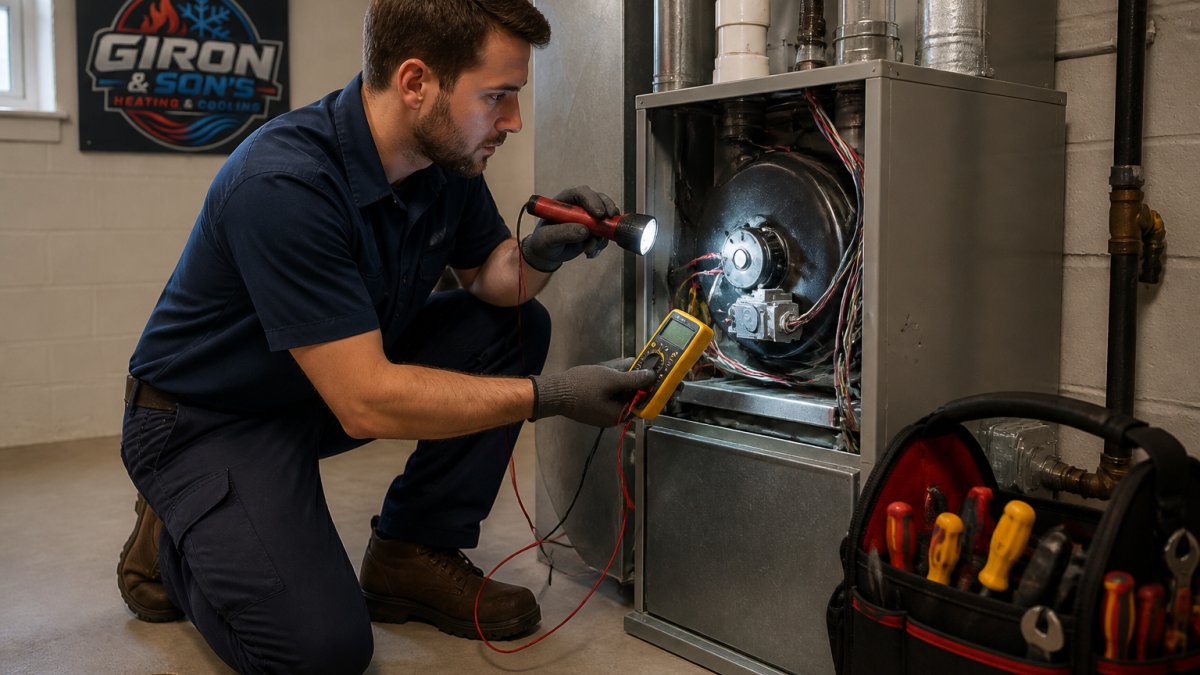
Watch for these warning signs:
- The furnace starts, runs briefly, then shuts off.
- Some rooms stay cold while others overheat.
- You hear banging, rattling, or squealing.
- The blower runs constantly or not at all.
- Energy bills climb without a change in usage.
The thing nobody tells you about rising bills is that a dirty filter or a failing blower can cause it. Neither requires a new furnace.
What a Professional Diagnostic Visit Should Cover
A diagnostic visit should end with a named failed part and a written repair estimate. Anything less is a sales call. Here is what a thorough inspection includes:
- Combustion analysis and venting check
- Heat exchanger inspection for cracks
- Blower motor amp draw and airflow test
- Ignition system and flame sensor test
- Thermostat calibration and wiring check
- Filter and ductwork inspection
- Carbon monoxide check near the unit
Ask for the findings in writing. A technician who cannot explain what failed, and why, has not finished the job.
Furnace Life Expectancy: Age Alone Is Not a Verdict
A gas furnace typically lasts 15 to 20 years with regular maintenance, and an oil furnace often runs a bit shorter. Those are averages, not deadlines. A well-maintained unit can outlast them, and a neglected one can fail early.
Petro notes that a properly maintained furnace 12 years old or younger should not need replacement yet, though older units may need repairs more often. Maintenance history matters more than the number on the data plate.
Ask three questions about any older furnace:
- Has it had annual maintenance?
- How many repairs in the last three years?
- Is the heat exchanger intact?
If the answers are yes, few, and yes, age is not your problem.
Furnace Repair Cost vs. Replacement Cost: Weighing the Numbers
Repair costs vary widely by part and labor, so we quote after diagnosis rather than over the phone. Replacement carries a much larger upfront figure plus installation variables. The comparison only makes sense once you have both numbers in hand.
What most homeowners need is a way to sanity-check a quote before they sign. Here is the cost context that makes the comparison concrete.
Typical Repair Cost Ranges
These are common U.S. ranges for the failed part plus labor. Treat them as a starting point, not a quote, access, part availability, and local labor rates move the number.
- Igniter replacement: roughly $150 to $400
- Flame sensor cleaning or replacement: roughly $100 to $300
- Thermostat replacement: roughly $150 to $500, depending on whether it is a basic or programmable model
- Blower motor replacement: roughly $400 to $1,200
- Control board replacement: roughly $400 to $1,000
- Inducer motor replacement: roughly $400 to $900
A single routine part swap usually lands well under the 50% threshold. A blower motor or control board can push toward it, which is why the next question, what else is aging, matters.
Typical Replacement Cost Ranges
A full replacement is a different order of magnitude. The upfront figure is only part of the story; installation quality and correct sizing affect how long the new unit lasts.
The Cost Variables That Move the Number
Two quotes for the same repair can differ by hundreds of dollars. Ask what is driving the difference:
- Part tier: OEM versus aftermarket, and whether the part is under warranty
- Labor rate: hourly versus flat-rate pricing, and after-hours or emergency premiums
- Access: a unit in a tight closet or attic takes longer to service than one in an open basement
- Diagnostic fee: some companies waive it when you approve the repair, some do not
- Permits and code items: replacement often triggers permit and venting or electrical updates that repair does not
Weighing the Numbers
Weigh these factors:
- Repair estimate for the specific failed part
- Replacement quote including installation and any ductwork changes
- Remaining service life of the current unit
- Efficiency gain from a new system, weighed against its cost
- Warranty coverage on parts and labor
A new furnace can lower operating costs over time, but it takes years to recover the upfront spend. If the current unit has several good years left, the math rarely favors replacement.
When Furnace Heat Exchanger Replacement Changes the Decision
A cracked heat exchanger is the one finding that shifts the decision toward replacement. The heat exchanger contains combustion gases, and a crack can let carbon monoxide into your home's air. That is a safety issue, not a maintenance one.
A cracked heat exchanger should be documented, and the unit should be shut down until it is addressed.
How to Evaluate a Replacement Recommendation Before You Agree
A replacement recommendation should survive three tests: a documented failed part, a repair estimate you can compare, and a clear reason repair is not viable. If any of those is missing, get a second opinion before you sign.
Ask these questions directly:
- What exactly failed, and can I see it?
- What would the repair cost?
- Why is repair not the better option here?
- Is the heat exchanger cracked, and where is that documented?
- What size unit are you proposing, and how did you calculate it?
Equipment sizing and improper installation cause real problems down the road. A quote that skips a load calculation is a red flag.
At Giron & Son's Heating & Cooling, we start with diagnostics and a repair-first mindset. As a veteran-owned business, we would rather fix what works than sell you a system you do not need.
A Step-by-Step Decision Framework for Repair vs. Replacement
Work through these steps in order. Stop at the first one that gives you a clear answer.
| Step | Question | If Yes | If No |
|---|---|---|---|
| 1 | Is there a safety issue, like a suspected cracked heat exchanger? | Shut down and replace | Go to step 2 |
| 2 | Has a technician named the failed part in writing? | Go to step 3 | Get a proper diagnosis |
| 3 | Is the repair under half the cost of a new system? | Repair it | Go to step 4 |
| 4 | Is the unit otherwise sound, with a good maintenance history? | Repair it | Go to step 5 |
| 5 | Have repairs piled up over the last few years? | Consider replacement | Get a second opinion |
Most homeowners land at step 3 or 4 and repair. The framework exists to keep you from skipping straight to step 5 on a salesperson's say-so.
A furnace that fails is a decision point, not a verdict. Get a real diagnosis, get the repair number in writing, and let the facts drive the choice.
If you are facing that decision now, Giron & Son's Heating & Cooling can help. We offer solid diagnostics, a repair-first approach when it makes sense, and clear communication about your options.
Frequently Asked Questions
How do I know if my furnace needs repair or replacement?
Start with the repair-versus-replacement threshold: if a repair costs more than 50% of a new furnace's price, replacement usually makes more sense. Below that, and especially on a furnace 12 years old or younger with a solid maintenance history, repair is often the better call. Petro notes that a properly maintained furnace at 12 years or younger should not need replacement yet. Also rule out ductwork, filter, thermostat, and airflow problems first, as these can mimic furnace failures.
Is it worth repairing a furnace that is 10 years old?
Usually yes, provided the heat exchanger is intact and the repair is a component-level fix such as a blower motor, ignition system, or thermostat. A 10-year-old furnace is still inside typical furnace life expectancy, and Petro's guidance says a well-maintained unit at 12 years or younger should not need replacement. Weigh the furnace repair cost against replacement cost, check whether the repair is covered by warranty, and confirm the diagnosis with a second opinion before committing to a new system.
Can a heat exchanger be replaced in a furnace?
Yes, a heat exchanger can be replaced, but the decision depends on furnace age, labor access, and total cost. On an older furnace, furnace heat exchanger replacement often approaches or exceeds the 50% threshold, at which point a new furnace is usually the smarter spend. A cracked heat exchanger is also a safety issue: it can let combustion gases including carbon monoxide into the home. If a technician finds a crack, stop using the furnace and get the venting and chimney inspected before restarting it.
What furnace repairs are usually worth making?
Component-level faults are typically worth fixing: a failed blower motor, a faulty ignition system, a bad thermostat, dirty flame sensors, or restricted airflow from filters and ductwork. These are repairable faults that restore heating performance without touching the heat exchanger or combustion path. What is usually not worth it: repeated repairs on a furnace past its service life, a cracked heat exchanger on an aging unit, or anything where the repair estimate plus recent repair history pushes total spend past half the price of a new furnace.
