Table of Contents
- Troubleshooting AC Unit Blowing Warm: What to Check First
- Check Your Thermostat Settings and Batteries
- Dirty Air Filter AC Symptoms and Replacement
- Inspect Airflow and Clear Blocked Vents
- AC Running But Not Cooling: Outdoor Unit Problems
- Frozen AC Evaporator Coil: Causes and Recovery
- When to Call an HVAC Technician for AC Problems
- Preventing Future Warm Air Issues
- Frequently Asked Questions
Last Updated: October 18, 2026
Troubleshooting AC Unit Blowing Warm: What to Check First
When your air conditioner blows warm air, the cause is usually one of a few common issues. Troubleshooting AC unit blowing warm doesn't always require a professional visit, though some situations do.
Many warm air problems are fixable without a service call; a few require professional attention right away. This guide walks through the diagnostic steps in order, starting with the safest and easiest checks.
Safety First: When to Stop and Call a Professional
Stop troubleshooting and call a professional if you notice:
- Sparks or burning smells coming from the outdoor unit or electrical box
- Hissing sounds from the outdoor condenser (sign of refrigerant leak)
- Visible damage to wiring or connections
Electrical problems can cause serious injury, and refrigerant requires EPA certification to handle. When in doubt, call. Giron & Son's technicians can diagnose any issue safely.
Check Your Thermostat Settings and Batteries
Most warm air calls trace back to the thermostat.
Check these settings first:
- Mode: Is it set to COOL, not FAN or HEAT?
- Temperature: Is the set temperature lower than the current room temperature?
- Fan setting: Switch between AUTO and ON to see if the compressor kicks in
If the thermostat is in the wrong mode or set too high, the system won't cool even though it's running.
Replace the batteries. Dead batteries stop the thermostat from signaling the compressor, so your AC blows room-temperature air.
If you have a programmable thermostat, check the schedule. A cooling cycle set for 6 PM won't activate at 2 PM. Reset the schedule or switch to manual mode temporarily.
Dirty Air Filter AC Symptoms and Replacement
A clogged air filter restricts airflow, so the evaporator coil gets too cold and can freeze.
- Weak airflow from supply vents
- Higher than normal dust on surfaces
- The filter looks gray or brown instead of white
Check your filter monthly and replace it every 1-3 months depending on pets, allergies, and dust levels.
How to replace it:
- Turn off the AC unit at the thermostat
- Locate the filter (usually near the furnace or in a wall-mounted return vent)
- Note the size printed on the frame (common sizes: 16x25x1, 20x25x1, 16x20x1)
- Slide out the old filter
- Insert the new filter with the arrow pointing toward the furnace
- Turn the system back on
A new filter costs $10-40. Wait 15-30 minutes after replacing it before judging whether it fixed the problem, since the system needs time to thaw a frozen coil.
| Problem | Symptom | Fix | Timeline |
|---|---|---|---|
| Dirty air filter | Weak airflow, warm air | Replace filter | 15-30 min to restore cooling |
| Thermostat batteries dead | AC won't turn on | Replace batteries | 5-10 min to restart |
| Wrong thermostat mode | System runs but doesn't cool | Switch to COOL mode | Immediate |
Inspect Airflow and Clear Blocked Vents
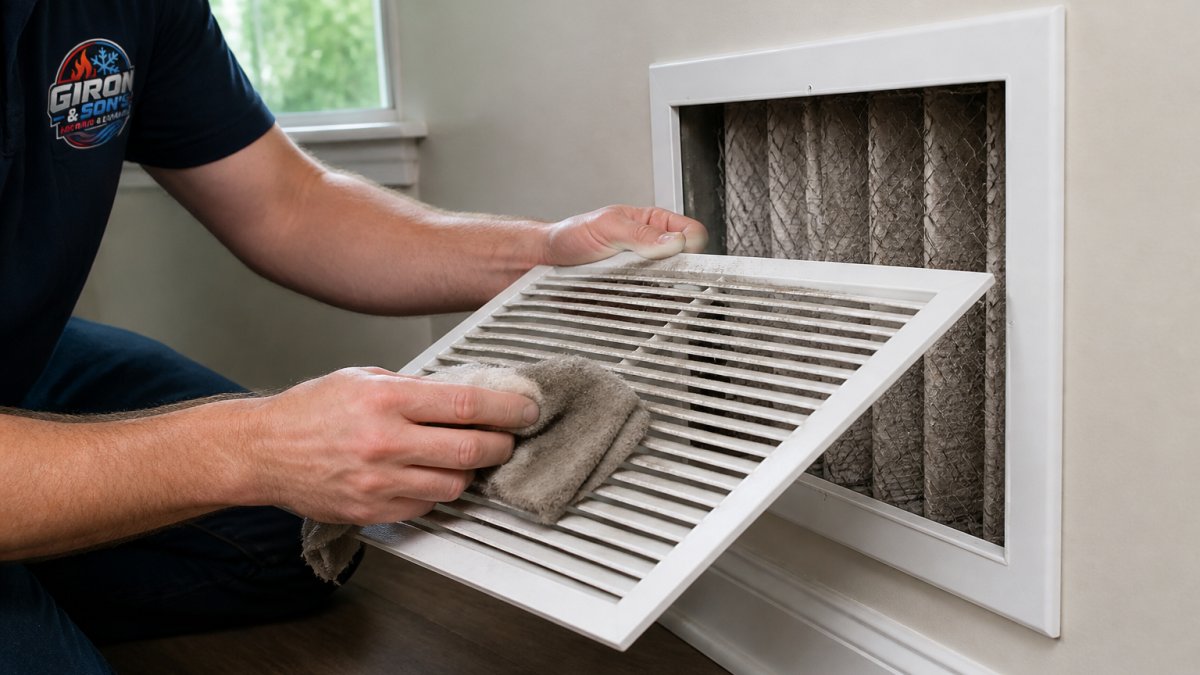
Blocked vents or ductwork prevent cool air from reaching your rooms. If the AC runs but warm air blows from vents, check for blockages.
Walk through your home and:
- Open all supply vents (the vents air comes out of)
- Check return vents (where air gets pulled back into the system) for dust buildup
- Move furniture, curtains, or other objects blocking vents
A single blocked return vent can starve the system of air, causing the evaporator coil to freeze and warm air instead of cold.
Check accessible ductwork in the basement or attic for disconnected or leaking ducts, ducts crushed by stored items, and kinked or twisted flexible ducts.
AC Running But Not Cooling: Outdoor Unit Problems
Safe visual checks you can do yourself:
- Is the fan running? You should hear it spinning and feel air blowing out the top
- Is there debris around it? (leaves, dirt, grass clippings)
- Is the power on? Check that the disconnect switch is in the ON position
A dirty outdoor condenser coil blocks heat transfer, so the system can't cool your home and you get warm air from the vents.
Clean the condenser coil:
- Turn off power at the outdoor disconnect switch
- Use a soft brush to remove loose debris
- Spray the coil gently with a garden hose (don't use high pressure)
- Let it dry completely before restarting
- Turn power back on
Keep the outdoor unit clear: at least 2 feet of clearance on all sides, trimmed bushes and trees, and no stored items against it.
Check the disconnect switch. This safety switch cuts power to the outdoor unit; if it's off, your AC runs but the compressor never starts. Look for a gray or metal box near the outdoor unit, the switch inside should point up (ON).
Check the circuit breaker. A tripped breaker cuts power to the condenser fan and compressor. Reset it by switching fully OFF, then back ON.
What the outdoor unit is telling you
Once power is confirmed and debris cleared, the outdoor unit's behavior narrows the diagnosis. Use this symptom map before deciding whether to keep going or call for service.
| What you observe | Likely cause | Safe next step |
|---|---|---|
| Fan not spinning, humming sound from unit | Failed condenser fan motor or capacitor | Turn system off; call a technician |
| Fan spinning, compressor silent | Contactor, capacitor, or compressor failure | Turn system off; call a technician |
| Unit clicks on and off every few minutes | Overheating compressor, low refrigerant, or failing capacitor | Turn system off; call a technician |
| Breaker trips when AC starts | Short circuit, grounded compressor, or bad capacitor | Leave breaker off; call a technician |
| Ice on the large refrigerant line | Low refrigerant or restricted airflow | Turn cooling off, run fan only, call a technician |
| Oil residue or hissing at line connections | Refrigerant leak | Do not touch; call an EPA-certified technician |
Capacitor failure is one of the most common reasons an outdoor unit hums but won't start.
Contactor failure shows up as a unit that gets power but never engages. Pitted or stuck contacts are a technician-level repair.
Compressor problems are the most expensive outdoor-unit failure.
If the outdoor unit has power, the fan runs, the coil is clean, and you still get warm air, the problem is likely refrigerant-side or compressor-side. Stop here and call a professional.
Frozen AC Evaporator Coil: Causes and Recovery
What causes a frozen coil:
- Dirty air filter (most common)
- Blocked return vents starving the coil of air
- Low refrigerant level
When the coil freezes, the system stops cooling to prevent damage, the warm air is the AC protecting itself.
How to thaw a frozen coil:
- Turn off the AC at the thermostat
- Switch the fan to ON (not AUTO)
- Leave it off for 2-4 hours while the fan runs
- Check the filter and replace if dirty
- Clear any blocked vents
- Turn cooling back on
The fan melts the ice without running the compressor. Once the coil thaws and you've fixed the underlying cause (usually a dirty filter), cooling should resume.
Do NOT turn the system back on until the coil is completely thawed. Running the compressor on a frozen coil causes damage that requires professional repair.
When to Call an HVAC Technician for AC Problems
Not every warm-air problem is an emergency, but some are. Use this urgency guide to decide whether to call now or schedule service this week.
Call immediately (same day)
These symptoms point to hazards or failures that get worse and more expensive the longer the system runs:
- Sparks, burning smells, or scorch marks at the outdoor unit or electrical panel
- A breaker that trips repeatedly when the AC starts
- Hissing or bubbling sounds at refrigerant lines (active leak)
Turn the system off at the thermostat before you call. Running a system with an active electrical fault or refrigerant leak can damage the compressor.
Schedule service within a few days
These problems still need a technician, but they aren't immediate safety hazards:
- The AC still blows warm air after you've checked the thermostat, filter, vents, and outdoor unit
- You suspect a refrigerant leak (hissing sounds, oil spots on the outdoor unit)
- The compressor won't start even though power is on
What to expect on cost
Repair costs vary widely by region, system size, and part availability, so treat any range as a planning number, not a quote. Generally:
- Capacitor replacement is one of the least expensive repairs, often a few hundred dollars including the service call
- Contactor replacement is similar in range
- Condenser fan motor replacement runs higher, typically several hundred dollars
Get a written diagnosis before authorizing any repair, and compare repair cost against system age. Rule of thumb: if a repair costs more than half the price of a new system and the unit is over 10 years old, consider replacement.
What not to attempt yourself
Refrigerant work requires EPA Section 608 certification. Handling refrigerant without it is illegal and dangerous. Capacitors, contactors, and compressor diagnostics require opening energized 240-volt equipment. Duct repairs inside walls or attics may be safe to inspect but should be repaired by a professional if sealed ducts are involved.
Giron & Son's Heating & Cooling technicians diagnose the root cause and give honest repair-or-replace advice based on your unit's age, condition, and repair history.
Preventing Future Warm Air Issues
Keep your AC running cool with simple maintenance.
Monthly tasks:
- Check and replace the air filter if it looks dirty
- Inspect return and supply vents for blockages
- Make sure the outdoor unit has clear space around it
Seasonal maintenance (spring, before cooling season):
- Have a professional inspect the system
- Check refrigerant level
- Clean the outdoor condenser coil
Preventive maintenance catches problems before they stop your cooling.
Set a calendar reminder to replace your filter, that single step prevents most warm-air problems, keeps airflow steady, prevents coil freeze-up, and extends your AC's life.
When your AC blows warm air, start with the easiest fixes: thermostat settings, battery replacement, and filter replacement. Most warm-air problems resolve with these steps. If cooling still hasn't returned, or you suspect refrigerant loss or compressor failure, contact Giron & Son's Heating & Cooling.
Frequently Asked Questions
Why is my AC blowing warm air?
Warm air from your AC unit usually points to one of several issues: thermostat set to heat mode instead of cooling mode, a dirty air filter restricting airflow, blocked vents around your home, a dirty outdoor condenser unit, low refrigerant levels, or a frozen evaporator coil. Start by checking your thermostat settings and air filter, then inspect your outdoor unit and vents. If these steps don't restore cool air within a few hours, contact a professional technician.
Can a dirty air filter make an AC blow warm air?
Yes. A clogged air filter restricts airflow through your HVAC system, causing the evaporator coil to freeze over time and reducing cooling capacity. This is one of the most common reasons for warm air complaints. Check your filter monthly and replace it every 1-3 months depending on household dust, pets, and system use. After replacing a dirty filter, wait 2-4 hours for the system to recover before expecting full cooling performance.
How long should I wait after changing an AC setting to see if it cools?
After adjusting your thermostat from heat to cool mode or lowering the temperature setting, allow 15-30 minutes for the system to respond. If you just replaced a dirty air filter, wait 2-4 hours for a frozen evaporator coil to thaw and the system to resume normal cooling. If warm air continues after these timeframes, move on to checking your outdoor unit and electrical connections, or call a technician.
When should I turn off my AC if it is blowing warm air?
Turn off your AC immediately if you notice an electrical burning smell, hear unusual grinding noises from the compressor, or see water pooling around your indoor unit. Otherwise, leaving the system running while you troubleshoot allows you to identify the problem. However, if your evaporator coil is frozen, turn off the AC and switch to fan-only mode to let it thaw. Avoid running a warm-air system in heat mode during summer, as this defeats cooling efforts.