Last Updated: November 12, 2026
Quick Summary
HVAC system lifespan varies by type: central air conditioners last 15-20 years, air-source heat pumps 10-15 years, gas furnaces 15-20 years, electric furnaces and boilers 20-30 years, and ductless mini-splits 15-20 years. Heat pumps have the shortest range because they run year-round for both heating and cooling. Maintenance, correct sizing, and clean filters determine whether your system reaches the top of its range.
- A heat pump's compressor, outdoor coil, and reversing valve typically last 10-15 years each.
- Change air filters every 1-3 months during cooling season to protect airflow.
- Short cycling from oversized equipment is a leading cause of shortened service life.
- Replace when a system passes 75% of expected lifespan or a repair exceeds one-third of replacement cost.
- National complete-system replacement runs $5,000 to $28,000 depending on type and scope.
Table of Contents
- HVAC Equipment Life Expectancy Chart: Every System Side by Side
- How Long Does a Heat Pump Last Compared With Other Systems?
- Split AC Lifespan: What Decides Whether Yours Reaches 20 Years
- Furnaces, Boilers, and Ductless Mini-Splits: Lifespan by Equipment Type
- What Shortens or Extends HVAC System Life Expectancy
- HVAC System Repair or Replace: How to Decide With Real Numbers
- Book a Diagnostic Visit Before You Decide on Replacement
- Frequently Asked Questions
HVAC Equipment Life Expectancy Chart: Every System Side by Side
HVAC system lifespan varies widely by equipment type, and the honest range is broader than most charts admit. Manufacturer guidance from Carrier's HVAC resources on system life expectancy puts general equipment life at 15 to 25 years, while Trane's published figures for air conditioners and heat pumps land closer to 10 to 12 years. Both are correct. They describe different equipment, different climates, and different maintenance histories.
That gap is the first thing to understand about HVAC system lifespan by type: there is no single number, only a range with conditions attached. Two homes on the same street can have systems installed the same year, with one nearing the end of its life while the other runs another decade.
The table below compares typical expected ranges by system type.
| System Type | Typical Expected Range | What Drives the Range |
|---|---|---|
| Central air conditioner | 15-20 years | Cooling hours, refrigerant type, coil condition |
| Air-source heat pump | 10-15 years | Year-round runtime, defrost cycles, climate severity |
| Gas furnace | 15-20 years | Heat exchanger condition, cycling frequency |
| Electric furnace | 20-30 years | Simpler design, fewer mechanical parts |
| Boiler | 20-30 years | Water quality, annual servicing, pipe condition |
| Ductless mini-split | 15-20 years | Filter care, indoor head placement, cleaning frequency |
Typical Expected Range
Read that table as a planning tool, not a countdown clock. A system at year 14 with clean coils and a documented service history is in better shape than one at year 9 that has never had a filter changed.
How Long Does a Heat Pump Last Compared With Other Systems?
The average heat pump lasts 10 to 15 years, which is shorter than a furnace or central AC for one straightforward reason: it runs year-round.
A heat pump handles both heating and cooling, so its compressor accumulates runtime in January and July alike, while a furnace sits idle all summer.
Cold-climate performance adds another variable. A heat pump working through a hard freeze cycles into defrost mode repeatedly, and that cycling is real wear. Systems sized correctly and paired with a backup heat source tend to last longer than oversized units short-cycling through winter.
A heat pump is not one lifespan. It is a stack of components with very different service lives, and knowing which one is aging can change the repair-or-replace decision:
| Component | Typical Service Life | What Shortens It |
|---|---|---|
| Compressor | 10-15 years | Short cycling, low refrigerant charge, voltage problems |
| Outdoor coil | 10-15 years | Coastal salt air, debris, hail damage |
| Indoor air handler | 15-20 years | Dirty blower wheel, condensate leaks |
| Reversing valve | 10-15 years | Repeated defrost cycling, debris in the refrigerant circuit |
| Thermostat | 8-12 years | Power surges, software age on smart models |
| Ductwork | 20-30 years | Leaky joints, poor insulation, pest intrusion |
That table matters because a 12-year-old heat pump with a healthy compressor and a failing reversing valve is a repair candidate, while the same unit with a failing compressor is usually a replacement.
Lifecycle cost is the other half of the comparison. A heat pump's lower operating cost in mild climates can offset a shorter service life, while a furnace's longer life can be undercut by higher fuel costs in cold regions.
If you are weighing a heat pump against a furnace for a home here, the heat pump vs furnace comparison for Illinois homes covers cold-weather performance, operating costs, and dual-fuel setups in detail. And if the question is whether a heat pump can replace your existing central system outright, whether heat pumps work as a central HVAC alternative answers that directly.
Watch out: defrost cycling is normal, but a heat pump that spends most of a cold snap in defrost is usually overcharged, undersized, or fighting a bad sensor, and that pattern will pull a 15-year unit down toward 10.
Split AC Lifespan: What Decides Whether Yours Reaches 20 Years
A split air conditioning system reaches 20 years when three things go right: correct sizing at installation, clean coils, and a compressor that never runs dry on refrigerant.
Installation quality is the one homeowners underestimate most. An oversized unit cools fast, shuts off, and short-cycles through the summer, and that on-off hammering wears the compressor faster than steady operation.
Refrigerant matters too. Systems built around older refrigerants face rising service costs as supplies tighten, so a slow leak that was a minor repair a decade ago can now push a system toward replacement simply because the charge is expensive to restore.
A practical checklist for supporting a long service life:
- Change the air filter every 1-3 months during cooling season
- Schedule professional servicing before each cooling season
- Keep the outdoor condenser clear of debris, leaves, and shade-blocking growth
- Fix refrigerant leaks promptly rather than topping off yearly
- Address small electrical or capacitor issues before they take the compressor with them
A failed capacitor is an inexpensive part, but a failure that is left unaddressed can damage other components such as the compressor.
Furnaces, Boilers, and Ductless Mini-Splits: Lifespan by Equipment Type
Lifespan varies by equipment type, and mechanical complexity and workload both affect how long a system lasts.
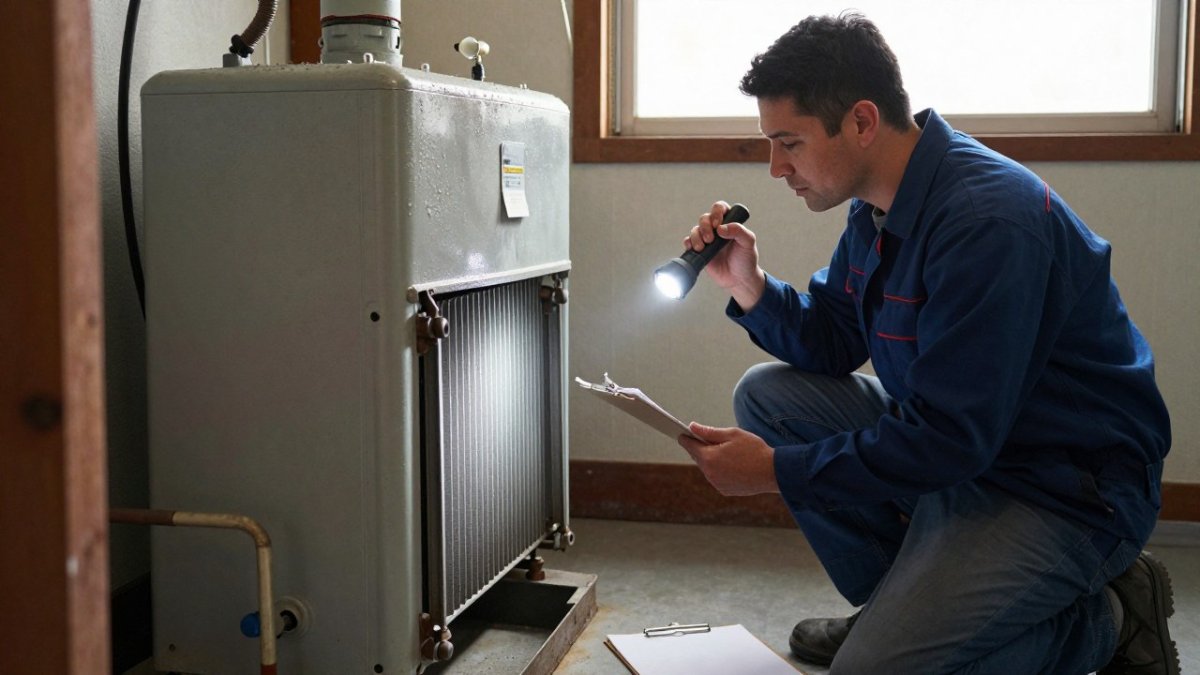
Gas furnaces carry a heat exchanger that endures thousands of heat-up and cool-down cycles. That thermal stress is the limiting factor, which is why annual exchanger inspection matters more than almost any other furnace task.
Boilers last longer because they have fewer moving parts and no forced-air cycle pushing dust through a cabinet. Water quality is the main threat: poorly maintained chemistry corrodes the exchanger from the inside, invisible until it is expensive.
Electric furnaces have no combustion and no heat exchanger to crack, which is one reason they are often associated with long service life. The elements and blower are the wear items, and both are serviceable.
Ductless mini-splits live or die on filter hygiene. Each indoor head has its own filter, and each is easy to forget. Clogged filters strain the blower and can ice up the coil, which shortens equipment life.
What Shortens or Extends HVAC System Life Expectancy
Maintenance is the largest single lever on HVAC equipment life expectancy, and the one homeowners control directly. Lifespan ranges generally assume some level of care, and neglecting it can shorten equipment life.
The factors that shorten service life, in rough order of impact:
- Short cycling from oversized equipment or a failing thermostat
- Dirty filters and coils, which force the system to work harder for the same output
- Refrigerant leaks left unaddressed season after season
- Improper charge from a previous installation or repair
- Corroded electrical connections that cause voltage drops and motor strain
- Deferred small repairs that cascade into compressor or heat exchanger failure
The factors that extend it are less dramatic. Annual professional servicing catches the small things. Filter changes protect airflow. Keeping the outdoor unit clear of debris protects heat rejection. None of it is glamorous, and all of it works.
Operating conditions matter as much as maintenance. A system in a home with heavy cooling demand, poor insulation, or leaky ductwork works harder every day. Sealing ducts and improving attic insulation lowers bills and reduces the runtime hours that count against your equipment's service life.
HVAC System Repair or Replace: How to Decide With Real Numbers
The repair-or-replace decision comes down to one comparison: the cost of the repair against the remaining value of the equipment.
That rule is a starting point, not an answer. The stronger method pairs expected lifespan with the three costs that actually accumulate: repair frequency, energy use, and the replacement itself.
Run the numbers on your own system with this framework:
| Question | If Yes | If No |
|---|---|---|
| Is the system past 75% of its expected lifespan? | Replacement deserves serious weight | Repair usually wins |
| Is the repair over one-third of replacement cost? | Replacement deserves serious weight | Repair usually wins |
| Has it needed two or more major repairs in three years? | Pattern suggests decline | Isolated failure, repair it |
| Is the heat exchanger cracked or the compressor failing? | Replacement | Repair |
| Are efficiency gains large enough to offset cost? | Replacement may pay back | Repair |
Component-level condition can inform the decision.
For national context on what replacement runs, Bryant's HVAC pricing guide reports a complete-system range of $5,000 to $28,000 depending on system type and scope.
Those are national figures, not local quotes, and they should inform the decision rather than make it. A repair-first approach means diagnosing the actual fault before pricing a replacement.
Weighing the full decision framework in more depth? Our guide on HVAC repair versus replacement walks through the factors that matter for Illinois homeowners. And when the numbers point toward a new system, you can review HVAC system replacement options in Monroe County, IL to see what is available.
The methodology behind all these lifespan ranges deserves a note. The Lawrence Berkeley National Laboratory's field evaluation of a systems approach to HVAC retrofits shows why whole-system performance matters more than any single component's rated life.
Watch out: a repair quote that seems cheap can hide a refrigerant charge or a duct repair that pushes the real cost past the replacement threshold, so ask for the full scope in writing before comparing numbers.
Book a Diagnostic Visit Before You Decide on Replacement
A diagnostic visit answers the question a lifespan chart cannot: what is actually wrong with your system right now. Age tells you probability. Diagnostics tell you fact.
We take a repair-first approach when practical. As a veteran-owned business, we focus on clear communication and solid diagnostics, because the honest answer to "do I need a new system" starts with finding out what is failing and why. If a repair makes sense, we say so; if a system has reached the end of its service life, we explain the reasoning.
Scheduling is available through our online booking, and you can learn more about our HVAC diagnostics and troubleshooting service in Monroe County, IL.
If your system is acting up and you are not sure whether it needs a repair or a full replacement, guessing gets expensive in both directions. Giron & Son's Heating & Cooling offers dependable diagnostics, a repair-first approach when it is practical, and clear explanations of what we find and why it matters. Get started with Giron & Son's Heating & Cooling and schedule a diagnostic visit so you can decide with facts instead of a countdown clock.
Frequently Asked Questions
Which HVAC systems last the longest?
Boilers and gas furnaces are often among the longer-lasting systems, though lifespan depends on equipment type, installation, and maintenance. Heat pumps and central air conditioners can run shorter because the compressor works year-round in both heating and cooling modes. Installation quality and annual servicing can help any system reach a longer service life.
How long does a heat pump last, and does climate matter?
Lifespan for air-source heat pumps varies. Climate matters because a heat pump in a cold-winter region runs more heating hours than one in a mild climate, and defrost cycles add wear. Units sized correctly and serviced each year can help extend service life.
Can a central AC unit last 30 years?
It is possible but uncommon. Central air conditioner lifespan depends on use, maintenance, and installation quality. Over time, refrigerant availability and parts support can become practical limits as well as the compressor's condition.
How do I know whether to repair or replace my HVAC system?
Weigh the repair cost against the system's age and remaining expected life. A repair that costs a large share of a replacement on an older unit may not be the best value. Repeated breakdowns, rising energy bills, and refrigerant that is no longer produced can all point toward replacement. A diagnostic visit can help you understand the options before you decide.
