
Last Updated: October 30, 2026
Quick Summary
A heat pump vs furnace choice depends on your home, your winters, and your existing fuel. Heat pumps move heat from outdoor air and also cool your home, while furnaces burn natural gas or propane and only heat. Many Illinois homes do well with a dual-fuel setup that pairs a heat pump with an existing furnace for the coldest days.
- A heat pump both heats and cools with one system, while a furnace only heats.
- A heat pump's output drops as outdoor temperatures fall, so it may need backup heat.
- Dual-fuel systems use the heat pump for mild weather and the furnace during extreme cold.
- Set the dual-fuel changeover near your economic balance point, not the factory default.
- Ask installers for estimates built on your last 12 months of utility bills.
Table of Contents
- How Heat Pumps and Furnaces Heat Your Home Differently
- Heating and Cooling Capabilities Compared
- Heat Pump Performance in Cold Weather Across Illinois
- Heat Pump Operating Costs vs Furnace: An Annual Cost Scenario
- Installation Costs, Equipment Lifespan, and Heat Pump Lifespan
- Dual Fuel Heat Pump System: Pairing a Heat Pump with Your Existing Furnace
- Booking a Heating Assessment for Your Illinois Home
- Frequently Asked Questions
Choosing between a heat pump vs furnace for an Illinois home depends less on which system is better overall and more on how your home is built, how cold your winters get, and what fuel your house already uses. Illinois winters swing from mild to brutal, so the right answer depends on how often your home sees both. Giron & Son's Heating & Cooling works with homeowners in Monroe County and surrounding communities every heating season, and this guide walks through the tradeoffs we see most often.
How Heat Pumps and Furnaces Heat Your Home Differently
A heat pump moves heat from outdoor air into your home. A furnace burns fuel, usually natural gas or propane, to create heat. That single difference drives almost every other tradeoff in this comparison.
Because a heat pump moves heat rather than creating it, it can deliver more heating energy than the electricity it consumes. A furnace converts fuel into heat at a fixed ratio. Read efficiency claims for both carefully, since outdoor temperature and local fuel prices change the real-world result.
Heat pumps usually supply air at a lower temperature than a furnace. Homeowners sometimes notice this as a gentler, longer heating cycle instead of a blast of hot air.
Heating and Cooling Capabilities Compared
A heat pump heats and cools with the same equipment. In summer it reverses direction and pulls heat out of your home, so one outdoor unit can replace a separate air conditioner. A furnace only heats, so cooling requires a separate air conditioner or a heat pump.
This matters most when a homeowner is replacing both systems at the same time. Consolidating heating and cooling into one heat pump can simplify the installation, though the equipment still has to be sized correctly for your home.
| Feature | Heat Pump | Furnace |
|---|---|---|
| Heating | Yes | Yes |
| Cooling | Yes, same system | No, needs separate AC |
| Fuel source | Electricity | Natural gas or propane |
| Typical supply air | Lower temperature, longer cycles | Higher temperature, shorter cycles |
Heat Pump Performance in Cold Weather Across Illinois
This is where most Illinois homeowners need the most guidance. A heat pump does not stop working in the cold, but its output drops as outdoor temperatures fall, and it may need supplemental heat during the coldest stretches.
Local conditions matter, so the seasonal balance between a heat pump and a furnace depends on where your home is.
Before choosing a heat pump, weigh the heat pump vs furnace question against your area's design temperature, and ask your installer how the system performs there, not just at a standard test condition.
Backup heat and sizing for cold snaps
A properly sized heat pump should handle most of your heating needs but is normally paired with backup heat for the coldest days, electric resistance strips in the air handler or an existing furnace. Undersized equipment struggles on cold nights; oversized equipment short-cycles and wastes energy. Size from load calculations based on insulation, windows, and air leakage, not the size of your old unit.
Heat Pump Operating Costs vs Furnace: An Annual Cost Scenario
Operating cost depends on your home, weather, and local utility rates, so it is best estimated from your own figures rather than a broad savings claim.
The formula that actually drives the answer
For any heating system, annual heating cost is:
Annual heating cost = (Heating load in Btu ÷ System efficiency) × Fuel price per Btu
For a furnace, efficiency is the AFUE rating (for example, 80% or 96%). For a heat pump, efficiency is the seasonal heating COP, which varies with outdoor temperature, that is why a single number cannot describe a heat pump's cost across an Illinois winter.
A worked scenario you can adapt
Assume a 2,000-square-foot home with a design heating load of about 40,000 Btu/h and an annual heating demand of roughly 50 million Btu (a common range for older Illinois housing; a Manual J load calculation gives you the real number for your home).
Why shoulder-season savings claims are real but limited
The deepest winter months are where the furnace's higher output and the heat pump's lower capacity and COP matter most, and where a dual-fuel changeover strategy (covered below) changes the math.
What to bring to your installer
Ask for a side-by-side estimate built on your last 12 months of utility bills, your home's square footage and insulation level, and the model-specific efficiency ratings of the quoted equipment. Any installer who gives a flat savings percentage without those inputs is guessing. A Manual J load calculation and a room-by-room ductwork review make the estimate defensible.
ENERGY STAR heating and cooling cost guidance
Installation Costs, Equipment Lifespan, and Heat Pump Lifespan
Installation cost is often a major factor in the decision, and it varies with home size, ductwork condition, and efficiency level. Request a written quote for current pricing.
Lifespan matters as much as upfront cost. Ask any installer to explain the expected service life of the specific model they recommend.
Dual Fuel Heat Pump System: Pairing a Heat Pump with Your Existing Furnace
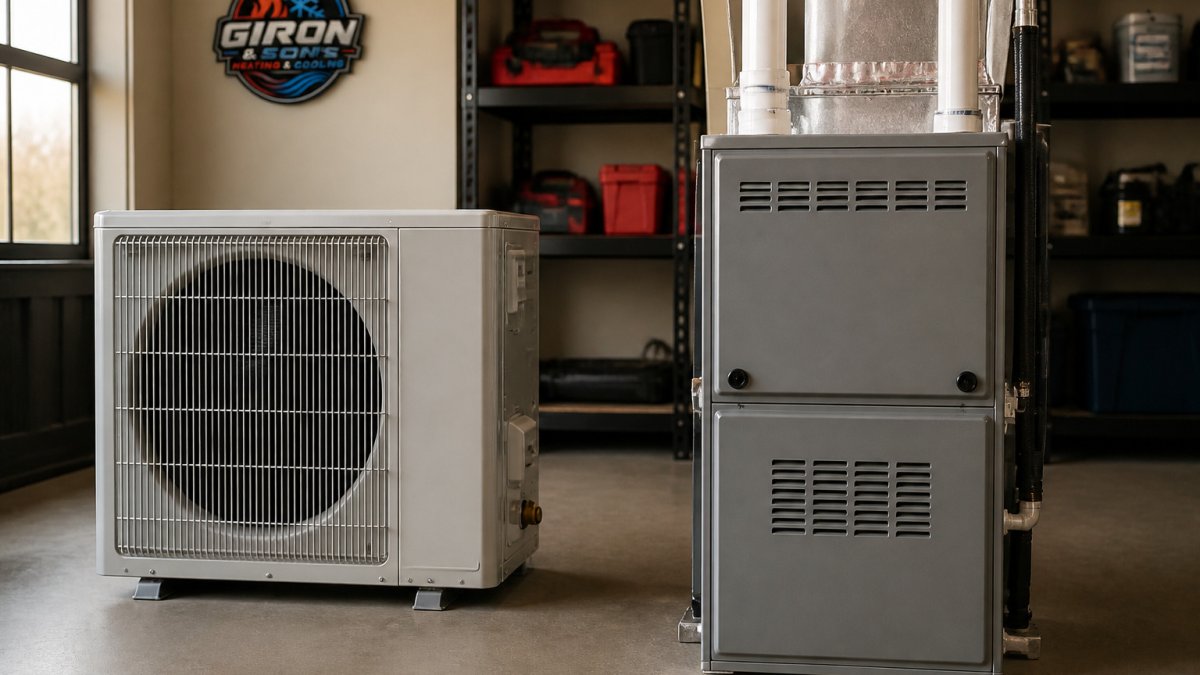
A dual-fuel system pairs a heat pump with your existing gas furnace. The heat pump handles mild weather, and the furnace takes over when temperatures drop below a set point. This setup often fits Illinois homes well, because it keeps the efficiency of the heat pump for most of the season while preserving the furnace's strength in extreme cold, but the changeover point is where most of the value is won or lost.
The balance point is the whole game
The balance point is the outdoor temperature at which your heat pump's capacity exactly matches your home's heating load. Above it, the heat pump can carry the house alone. Below it, something else has to make up the difference, either electric resistance strips or the furnace.
A thermal balance point is set by the equipment and the house. An economic balance point is set by your utility rates: the outdoor temperature at which heat pump cost per Btu equals furnace cost per Btu. The two are rarely the same, and the economic balance point should drive your changeover setting if your goal is lowest annual cost.
How to set the changeover temperature
- Get the capacity table for the specific heat pump model. Manufacturers publish heating capacity at 47°F, 35°F, 17°F, and 5°F. Compare those numbers to your Manual J load at the same temperatures.
- Calculate the economic balance point. Using the cost-per-million-Btu method from the operating cost section, find the outdoor temperature where the heat pump's COP makes its delivered heat more expensive than the furnace's. With typical Illinois rates, that crossover often lands somewhere in the 25°F to 35°F range, but it moves with your rates and equipment.
- Set the changeover at or slightly below the economic balance point. Setting it too high runs the furnace more than necessary and gives up heat pump savings. Setting it too low lets the heat pump run in conditions where it struggles and may trigger resistance backup heat, which is expensive.
- Lock out resistance heat above the balance point. Electric strip heat has a COP of about 1.0, so it should only run during defrost cycles or as emergency backup, not as routine supplemental heat.
Controls that make dual-fuel work
A dual-fuel system needs a control that can stage the heat pump and furnace and enforce the changeover. Options include a dual-fuel-capable thermostat, a fossil-fuel kit on the air handler, or a communicating system from the equipment manufacturer. Whatever the control, it should support:
- A programmable outdoor changeover temperature
- A lockout on resistance heat above the balance point
- Defrost cycle management so the furnace or strips cover the air during defrost
- A manual emergency-heat mode for service or extreme cold
When dual-fuel is the right call, and when it isn't
Dual-fuel makes the most sense when you already have a working gas furnace with remaining life, your electrical panel can support the heat pump without a major upgrade, and your rates make the heat pump cheaper for most of the heating season. It makes less sense when the existing furnace is near end of life, when you want to eliminate gas service entirely, or when a cold-climate heat pump sized to your design temperature can carry the load without backup.
DOE guidance on dual-fuel and cold-climate heat pump systems
Booking a Heating Assessment for Your Illinois Home
The right choice depends on your home, your budget, and your local climate, and most of those answers come from a proper evaluation rather than a generic guide.
If you are weighing these choices now, schedule furnace diagnostics or request a heating assessment through our online booking. Pricing depends on your home's size, equipment, and the work required, so contact us for a quote tailored to your property.
Frequently Asked Questions
Is a heat pump good for Illinois winters? A heat pump works well in mild and moderate Illinois winter weather.
How much does a heat pump cost to install in Illinois? Atlas Total Home lists an installed cost of $10,000 to $25,000 for a heat pump that replaces both heating and cooling equipment. Final pricing depends on your home and the equipment selected.
Can I keep my existing furnace if I add a heat pump? Yes. A dual-fuel system pairs a heat pump with your existing gas furnace, and it is often a practical option for cold-climate homes.
Frequently Asked Questions
Is a heat pump or furnace better for an Illinois home?
Neither is better in every case, and the right choice depends on your local climate and your home. Many Illinois homeowners choose a dual-fuel setup, which uses the heat pump for most of the heating season and switches to the furnace when temperatures drop below a set point. The right choice depends on your local climate, your existing ductwork, and how your home is currently heated.
Can a heat pump keep a home warm during an Illinois winter?
A heat pump can heat an Illinois home through most of the winter, especially in shoulder seasons and milder cold spells. During extended extreme cold, a heat pump may need supplemental or backup heat to maintain comfort. Cold-climate models and properly sized equipment perform better in low temperatures. A dual-fuel system with a furnace as backup is a common way to keep the home warm during the coldest stretches.
Are heat pumps cheaper to run than gas furnaces in Illinois?
Operating costs depend on local electricity and natural gas rates, the outdoor temperature, and how efficiently each system runs. Savings are not guaranteed across all seasons or households. Compare your actual utility rates and past bills before deciding, since savings in colder months may be smaller.
How much does it cost to install a heat pump or furnace?
Installed costs vary by system size, efficiency, and the work needed for your home. Pricing depends on the equipment, home layout, and installation requirements, so request a written quote from Giron & Son's Heating & Cooling on our website for current figures.
