Quick Summary
HVAC diagnostics require professional expertise because a single symptom, like warm air from a vent, can come from many different causes such as low refrigerant, a failing compressor, or a bad capacitor. Each cause needs a different repair, and interpreting the measurements that identify the right one takes training.
- Diagnosis starts with the complaint and system history, then moves to visual inspection and operating conditions.
- Pressure, temperature and electrical readings are compared against manufacturer specifications.
- Refrigerant leak diagnosis requires specialized equipment and, in the United States, EPA Section 608 certification.
- A single out-of-range reading is not a diagnosis; ask what else was ruled out before approving parts.
- A diagnostic visit should end with a written diagnosis naming the cause and the repair options.
Table of Contents
- What Makes HVAC Diagnostics Harder Than They Look
- Why Your AC Is Blowing Warm Air: Several Causes, One Symptom
- How a Technician Works Through a Diagnosis Step by Step
- Refrigerant Leak Diagnosis Requires Certification and Equipment
- What to Expect From an HVAC Diagnostic Service Visit
- Repair vs. Replacement: How Accurate Diagnosis Decides the Answer
- Booking Your Diagnostic Visit With Giron & Son's Heating & Cooling
- Frequently Asked Questions
What Makes HVAC Diagnostics Harder Than They Look
Last Updated: November 7, 2026
A common pattern is a homeowner who notices the AC is off, swaps a filter or resets a breaker, and assumes the job is done. Often it isn't. HVAC diagnostics involve more moving parts than most people expect, and the symptom you see is rarely the whole story. A systematic review of AI-based HVAC fault detection notes that diagnosing faults has long depended heavily on expert knowledge, which is one reason the work is hard to do well without training. AI in HVAC fault detection and diagnosis: A systematic review
A heating and cooling system is a set of connected parts: the thermostat, control board, blower, compressor, coils, refrigerant lines, ductwork and electrical circuits. A fault in one part can produce symptoms that look like a fault in another. That overlap is what makes the work difficult.
Diagnosis also depends on conditions. A system can run fine on a mild spring day and fail on the first hot afternoon, which is why testing under real operating load matters.
- Symptoms overlap across different components
- Faults often appear only under specific temperatures or loads
- Some problems are hidden inside sealed refrigerant or electrical circuits
- Guessing at a fix can hide the real cause and add cost
Why Your AC Is Blowing Warm Air: Several Causes, One Symptom
Warm air from a vent is one of the most common calls we hear, and it is a clear example of why diagnosis matters. The same symptom can come from very different causes. Low refrigerant, a failing compressor, a frozen evaporator coil, a bad capacitor, a blocked condenser or a thermostat set wrong can all leave you with warm air.
Each cause points to a different repair. Adding refrigerant to a system with a leak fixes nothing and wastes money. Getting the cause right is the key to an effective repair.
If you want to check for compressor trouble yourself, our guide on 7 Signs Your AC May Have Compressor Trouble lists the warning signs and when to call a professional. For the basic checks you can safely do before calling, see Troubleshooting AC Unit Blowing Warm: A Step-by-Step Guide.
How a Technician Works Through a Diagnosis Step by Step
A good diagnosis follows a sequence. It starts broad and narrows down, and skipping steps can turn a quick fix into a second visit.
- Confirm the complaint and the history of the system
- Inspect the equipment visually, inside and out
- Check operating conditions, such as temperatures and airflow
- Take pressure, temperature and electrical measurements
- Compare the readings to the manufacturer's specifications
- Identify the root cause and confirm it before recommending a repair
- Verify the repair under real operating load before closing the ticket
!A licensed HVAC technician in a work uniform using a digital manifold gauge and multimeter beside an outdoor condenser unit on a sunny residential property
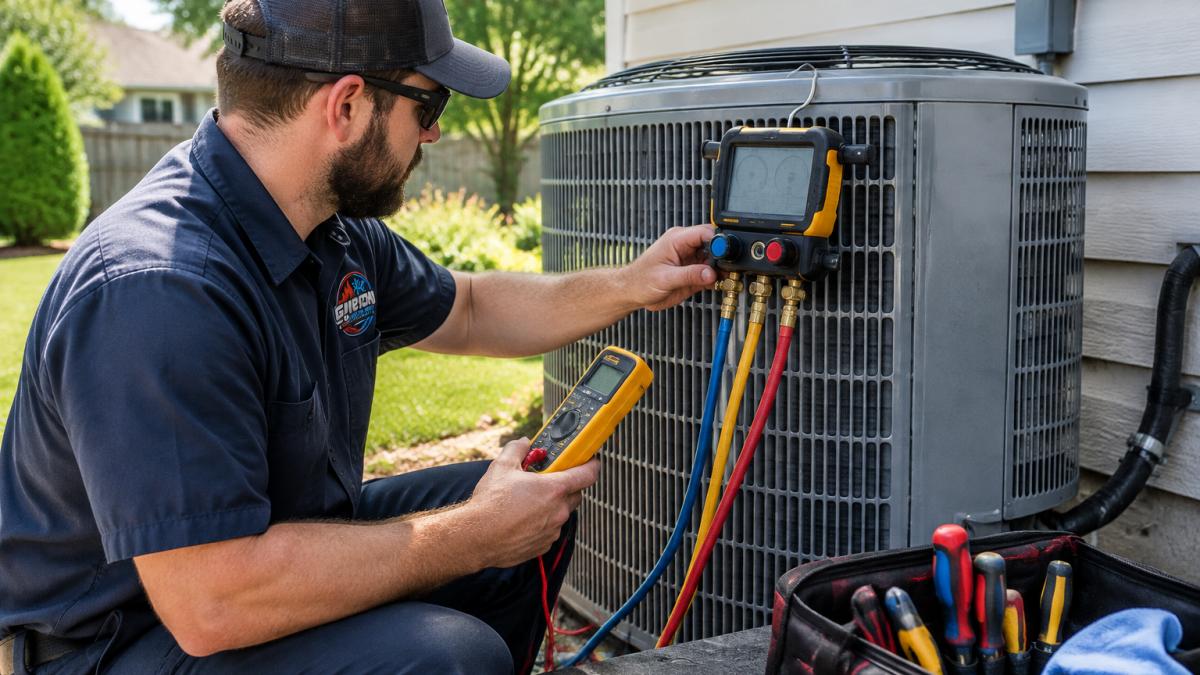
Visual inspection and operating conditions
Visual inspection catches a lot. A technician looks for oil stains near fittings, a dirty coil, a cracked belt, a loose wire or ice on the evaporator. These clues can help narrow the list of possible causes.
Operating conditions matter just as much. Airflow, return air temperature and how long the system runs all shape what a reading means. A system with a clogged filter can show readings that mimic a refrigerant problem. That is why a technician checks the filter, the blower wheel and the return static pressure before trusting a low suction pressure as evidence of a charge issue.
Pressure, temperature and electrical measurements
Measurements can turn a guess into a finding. Readings such as suction and discharge pressures, temperature difference across the evaporator, and voltage and amperage are typically compared against manufacturer specifications.
Interpreting these numbers takes training. A pressure that looks low may be normal under certain airflow conditions, which is why reading several measurements together matters.
Watch out: a single out-of-range reading is not a diagnosis. If a technician recommends a part replacement without showing you the supporting measurements, ask what else was ruled out first.
A good diagnosis follows a clear sequence, from the initial complaint through to verifying the repair.
| Step | What the technician does | Purpose |
|---|---|---|
| 1. Confirm complaint | Review the complaint and system history | Set the starting point |
| 2. Visual inspection | Inspect equipment inside and out | Spot visible clues |
| 3. Operating conditions | Check temperatures and airflow | Read results in context |
| 4. Measurements | Take pressure, temperature and electrical readings | Turn guesses into findings |
| 5. Compare to specs | Check readings against manufacturer specifications | Confirm what is out of range |
| 6. Root cause | Identify and confirm the cause before recommending repair | Avoid wrong parts |
| 7. Verify repair | Test the repair under real operating load | Confirm the fix works |
Refrigerant Leak Diagnosis Requires Certification and Equipment
Refrigerant problems are where DIY diagnosis is most risky. Finding a leak takes specialized leak detection equipment, and handling refrigerant is regulated. In the United States, the EPA requires technicians who work with regulated refrigerants to hold Section 608 certification. EPA Section 608 refrigerant certification requirements
Certification matters because improper handling can release refrigerant into the air and harm the equipment.
What to Expect From an HVAC Diagnostic Service Visit
A diagnostic visit is a structured inspection, not a repair. The technician examines the system, runs tests and explains what they found. A diagnostic visit can end with a written diagnosis that names the failed component or confirmed cause and the repair options. You can book a residential HVAC diagnostic visit in Monroe County through our local diagnostics page. For current pricing, contact Giron & Son's Heating & Cooling directly.
Many companies charge a diagnostic fee separate from repair pricing. Ask up front whether the fee is credited toward the repair if you approve the work, and whether the quote is flat-rate or an estimate that can change once the unit is opened.
Questions that separate a diagnosis from a guess
Use these questions during or after the visit. A technician who did the work can answer them specifically; one who replaced a part on suspicion usually cannot.
- What were the actual readings, and what does the manufacturer specify for this model under today's conditions?
- Which possible causes did you rule out, and what test ruled each one out?
- Is the failed part the cause of the symptom, or a symptom of another problem?
- If we replace this part and the symptom remains, what is the next step and who pays for it?
- What is the repair cost, the expected lifespan of the repair, and the alternative if I choose replacement?
- Will you show me the old part and the readings before and after the repair?
A written diagnosis should reference the model and serial number and the measured values. If the paperwork only says "bad capacitor" or "needs recharge" with no numbers, the diagnosis is thin.
Red flags during a diagnostic visit
A common pattern is a technician who quotes a full system replacement before any measurement has been taken, or who recommends a recharge without first locating and repairing a leak. Recharging a leaking system is a temporary fix that returns the same symptom within a season. Another red flag is a diagnosis that changes after you decline the first repair, with no new test to justify the change.
You should be able to leave the visit with a written diagnosis and the choice to move forward or not. A company confident in its diagnostics will not pressure you to decide on the spot.
Repair vs. Replacement: How Accurate Diagnosis Decides the Answer
The question of repair or replacement depends on the diagnosis. A failed capacitor is often a smaller repair, while a cracked heat exchanger on an older unit may push the decision toward replacement. Without an accurate diagnosis, you cannot make that call well.
A repair-first approach is worth considering when a repair makes sense for the system. Replacement is generally recommended only when the numbers and the equipment's condition support it.
Booking Your Diagnostic Visit With Giron & Son's Heating & Cooling
As a veteran-owned business, we focus on clear communication and solid diagnostics. If your system is blowing warm air, cycling oddly or showing other symptoms, schedule an appointment online or contact us today to have a technician take a closer look.
Frequently Asked Questions
Can I diagnose an HVAC problem myself?
You can safely check a few things yourself, such as whether the thermostat is set correctly, whether the air filter is clogged, whether the outdoor unit is blocked by debris, and whether the circuit breaker has tripped. Beyond that, most diagnosis requires measuring refrigerant pressures, electrical voltage and temperature differentials, which needs specialized gauges and training. Working near live electrical components and refrigerant lines also carries real safety risk. If the basic checks do not restore normal operation, a licensed technician can take the measurements needed to find the actual cause.
Why is my AC blowing warm air?
Warm air from an air conditioner can come from low refrigerant, a failed compressor, a dirty condenser coil, a faulty capacitor, a frozen evaporator coil from restricted airflow, or a control or thermostat problem. Several of these produce the same symptom, which is why guessing usually leads to replacing the wrong part. A technician checks operating pressures, temperature split across the coil and electrical components to narrow the cause before recommending a repair.
Why do HVAC technicians need certification to handle refrigerants?
EPA Section 608 certification is generally required for anyone who buys or handles regulated refrigerants. The rule exists because venting refrigerant harms the ozone layer and because improper handling can damage equipment and injure people. Certification also confirms the technician understands leak detection and recovery procedures. Homeowners should confirm a company's technicians hold current Section 608 certification before authorizing refrigerant work.
How much should an HVAC diagnostic cost?
Diagnostic fees vary by company, region and whether the fee is credited toward a repair. Giron & Son's Heating & Cooling does not publish a fixed diagnostic price in this article, because the cost depends on the equipment and the visit. For current pricing, contact Giron & Son's Heating & Cooling directly or book online to get a quote before the visit. Ask whether the diagnostic fee applies toward the repair if you proceed.
