
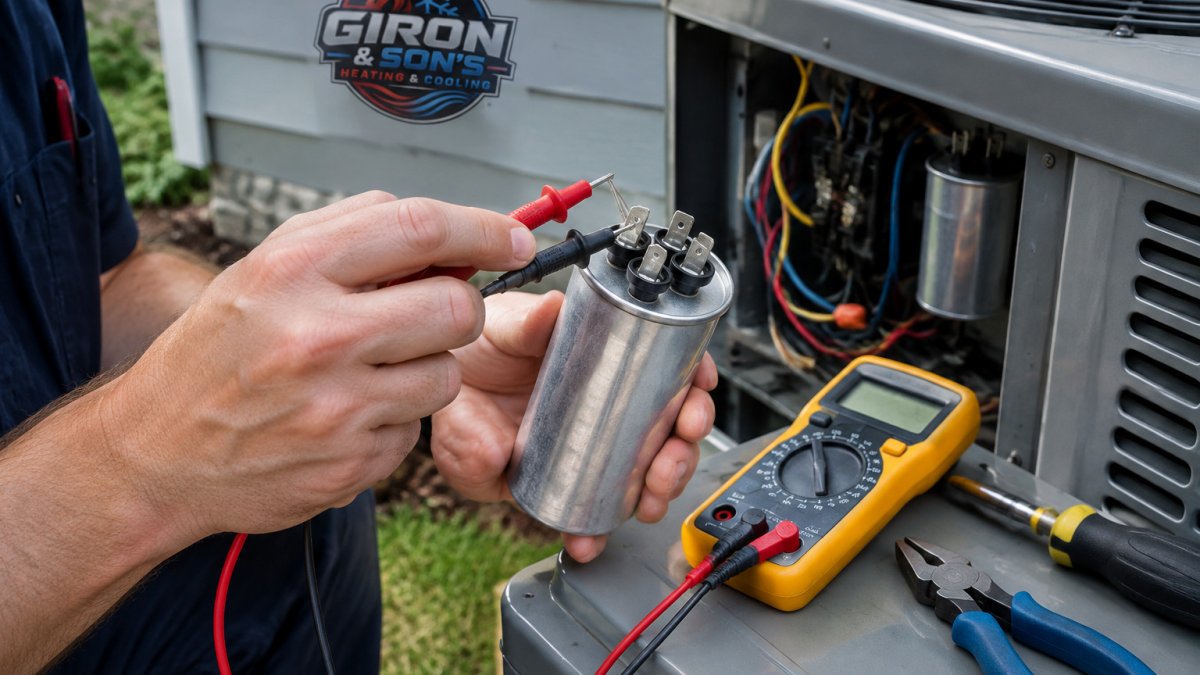
Quick Summary
A bad AC capacitor usually shows up as a unit that hums but won't start, a slow or stalled outdoor fan, or repeated clicking at startup. Visible bulging, oil leaks or burn marks confirm the problem. A multimeter capacitance test gives the most reliable answer.
- Check for a bulged or swollen top, oil leaks, rust or burn marks.
- Discharge the capacitor and cut power at the disconnect before touching it.
- Compare multimeter readings to the printed rating, within the stated tolerance.
- Replace a capacitor that reads well below its rating or shows zero, a short or an open circuit.
- Do not keep resetting a breaker that trips repeatedly, as it can damage the compressor.
Table of Contents
- Common Symptoms of a Failing AC Capacitor
- Visual Inspection: Signs of Capacitor Damage
- Safety First: Discharging and Handling a Capacitor
- How to Tell If an AC Capacitor Is Bad With a Multimeter
- Testing a Capacitor Without a Multimeter
- How Long an AC Can Run With a Bad Capacitor
- Booking a Capacitor Check or Replacement With Giron & Son's
- Frequently Asked Questions
Common Symptoms of a Failing AC Capacitor
Last Updated: November 17, 2026
If your air conditioner has stopped cooling the way it used to, a bad capacitor is one of the most likely causes.
A capacitor is a small, cylindrical part inside the outdoor unit. It gives the compressor and the fan motor the jolt of electricity they need to start and keep running.
Mister Sparky lists several common warning signs, including the unit struggling to start, clicking or humming sounds, inconsistent cooling and frequent cycling. Mister Sparky's 2026 guide to electrical signs of bad capacitors
Watch for these symptoms:
- The unit hums but won't start. The outdoor fan or compressor tries to turn but can't get going.
- The fan spins slowly or not at all. A weak capacitor often leaves the fan sluggish.
- Clicking sounds at startup. The contactor may click repeatedly as it tries to engage.
- Warm air from the vents. The system runs, but it can't cool the home properly.
- Frequent shutdowns. The unit may turn on, run briefly, then cut off.
- The system cycles on and off. Short, repeated runs can point to a capacitor that's failing under load.
Separating Capacitor Symptoms From Other AC Faults
Many of these signs overlap with other problems, and that overlap is where most homeowners guess wrong. Use this quick flow to narrow the cause before you reach for a meter.
- Nothing happens at all, no hum, no fan, no click. Check the thermostat setting and batteries, then the breaker and the outdoor disconnect. A capacitor failure usually leaves some sign of life; a completely dead unit more often points to power supply, a tripped breaker, or a thermostat problem.
- Contactor clicks repeatedly but the fan and compressor never start. A weak capacitor is a strong suspect, but a pitted or stuck contactor can produce the same clicking. Look at the contactor points for burning or pitting before assuming the capacitor.
- Fan spins only when you push it, compressor runs. This pattern points to the fan side of a dual-run capacitor rather than the compressor side. A seized fan motor bearing can mimic it, so spin the blade by hand with power off, if it drags or grinds, the motor is the problem, not the capacitor.
- Compressor hums and trips the breaker within seconds. A failed capacitor can cause this, but so can a failing compressor or a loose wire. Stop and call a technician; repeated trips can damage the compressor.
- System runs but cooling is weak. A weak capacitor is possible, but low refrigerant, a dirty condenser coil, or a restricted filter are more common. Check airflow and the filter first.
- Unit shuts off after a few minutes and restarts later. This can be a capacitor weakening under heat, but it also matches an overheating compressor or a control board fault. Note whether the shutdown happens on the hottest part of the day.
A common pattern is that capacitor symptoms show up at startup, humming, slow fan, repeated clicks, while refrigerant and airflow problems show up as weak cooling during a run.
Watch out: do not keep resetting the breaker on a unit that trips repeatedly.
Visual Inspection: Signs of Capacitor Damage
Before you test anything, take a close look at the capacitor. Many failing units show visible damage.
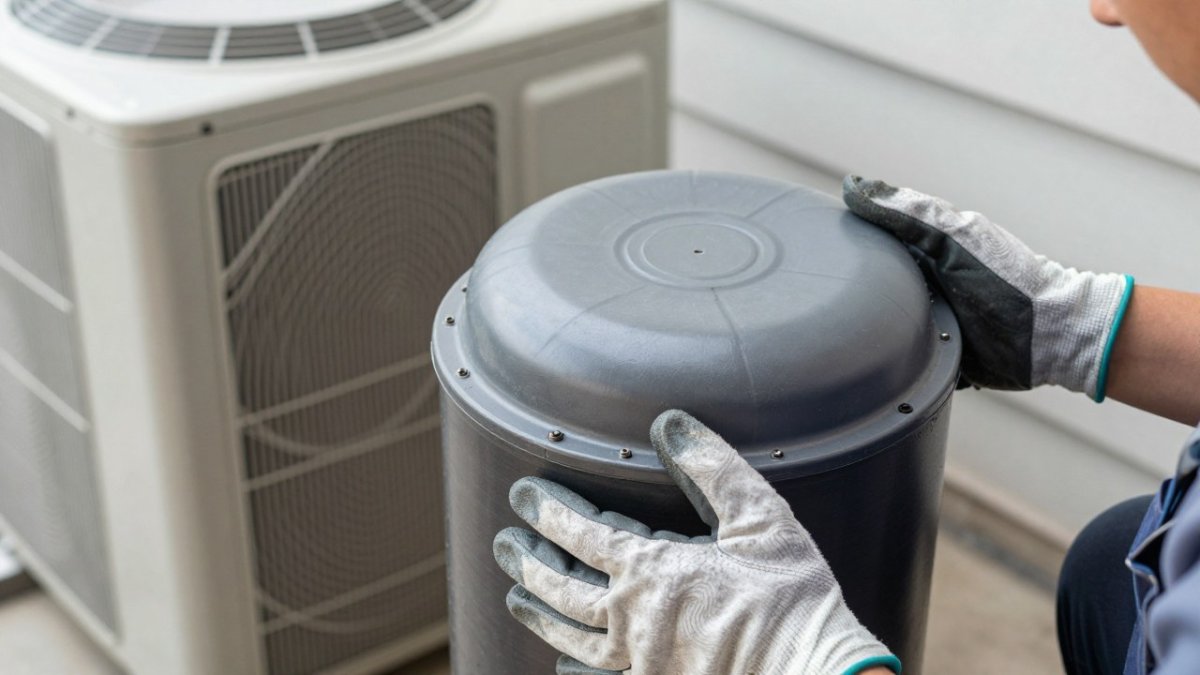
Look for these signs:
- A bulged or swollen top. This is the most common visual clue. A healthy capacitor has a flat top.
- Oil leaking from the case. Any residue around the base means the capacitor is likely failing.
- Rust or corrosion on the terminals or casing.
- Burn marks or discoloration near the connections.
- A cracked or split casing.
A 2026 HVAC technical resource on capacitor visual inspection notes that a top that is significantly bulged or swollen is a clear sign the capacitor has failed. If you see any of these signs, replace the capacitor. Don't try to repair it.
Safety First: Discharging and Handling a Capacitor
Capacitors store electrical energy, even after the power is off. A capacitor that has been sitting in a running system can still hold a dangerous charge. Treat every capacitor as live until you prove otherwise.
Follow these steps before you touch anything:
- Turn off power at the disconnect box next to the outdoor unit. Then switch off the breaker at the main panel.
- Confirm the power is off with a voltage tester.
- Discharge the capacitor using a insulated resistor or a screwdriver with an insulated handle. Touch across the terminals, not your hands or bare metal.
- Wear insulated gloves and eye protection when handling the unit.
- Never bridge the terminals with a bare wire or a tool.
Watch out: A high-voltage capacitor can deliver a serious shock even when the unit appears off. If you aren't comfortable working near live electrical parts, call a licensed technician.
How to Tell If an AC Capacitor Is Bad With a Multimeter
A multimeter gives you the clearest answer, but only if you know which capacitor you are testing and which terminals to probe.
On a dual-run capacitor, the label typically lists two capacitance values, a higher one for the compressor (often labeled HERM) and a lower one for the fan (often labeled FAN), plus a shared common terminal (C). Some labels also list a third value for a start winding. Match each printed value to its labeled terminal pair: C to HERM for the compressor side, C to FAN for the fan side.
Set the meter to measure capacitance, usually marked with a symbol like "μF" or "MFD." Here is the process:
- Confirm the capacitor is fully discharged using the safety steps above.
- Photograph the wiring or label each wire before disconnecting it, then disconnect the wires from the terminals.
- Connect the multimeter probes across the terminal pair you are testing, C to HERM, then C to FAN.
- Read the capacitance value on the display and compare it to the rating printed for that pair.
- Repeat for the start capacitor if your system has one, comparing against its single printed rating.
A 2026 HVAC diagnostic video on multimeter capacitor testing shows that voltage readings can help too. A capacitor reading auto voltage on a common wire is generally a sign of failure, while a healthy hermetic-wire reading stays within a safe range.
Reading Capacitance Values and Tolerances
Every capacitor has a rated value, printed in microfarads (μF or MFD).
Here is how to read your results:
- Within the tolerance range: The capacitor is likely healthy. A 45/5 μF capacitor rated ±6% should read roughly 42.3 to 47.7 μF on the HERM side and roughly 4.7 to 5.3 μF on the FAN side.
- Slightly below the rating but inside tolerance: The capacitor is still in spec. Note the reading and recheck it if symptoms return.
- Below the tolerance window: The capacitor is weak and out of spec. Plan a replacement rather than waiting for a full failure.
- Well below the rating, or zero: The capacitor has failed.
- Reads as a short or an open circuit: Replace it immediately.
Watch out: a meter with a weak battery or a test performed with the wires still connected can produce a false low reading.
Always replace a capacitor with one that has the same microfarad rating and voltage rating. A higher voltage rating is safe. A lower one is not.
The meter readings to compare against the printed ratings are summarised below.
| Reading | What it means | Action |
|---|---|---|
| Within tolerance (e.g. 42.3-47.7 μF for 45 μF ±6%) | Likely healthy | Note reading, recheck if symptoms return |
| Slightly below rating, still in tolerance | Still in spec | Monitor |
| Below tolerance window | Weak, out of spec | Plan replacement |
| Zero, short or open circuit | Failed | Replace immediately |
| Fan side low, compressor side near spec | Matches slow or stalled fan | Check fan side closely |
Testing a Capacitor Without a Multimeter
No meter? You can still gather useful clues.
- Check for visual damage using the steps above.
- Listen during startup. A humming outdoor unit that won't turn over often points to a weak capacitor.
- Watch the fan. If the fan blades start slowly, or only spin after you give them a push, the capacitor is a suspect.
- Note the pattern. Repeated failed starts paired with clicking suggest the capacitor, though a compressor problem can cause the same symptoms.
These checks can point you in the right direction, but they can't confirm a bad capacitor. A meter test is the only reliable way to be sure.
How Long an AC Can Run With a Bad Capacitor
A failing capacitor doesn't always stop the system right away. Many homeowners run a unit for weeks or months with a weak capacitor before it fails completely.
That's a risk. Running a unit with a bad capacitor forces the compressor and fan motor to work harder. Extra strain can overheat the motor and lead to a much more expensive repair. If you notice any of the symptoms above, don't wait to get it checked.
Booking a Capacitor Check or Replacement With Giron & Son's
If you've worked through these steps and still aren't sure what's wrong, a professional check is the fastest route. You can find HVAC repair and service in Columbia, IL from Giron & Son's Heating & Cooling, including diagnostics and capacitor replacement.
If you're deciding whether a professional visit is worth the cost, our HVAC diagnostic cost overview explains typical pricing. Costs vary by company and region, so ask for a quote before you schedule.
Giron & Son's Heating & Cooling offers dependable residential HVAC service for homeowners in Monroe County and surrounding Illinois communities. You can book AC repair service online or read our step-by-step troubleshooting guide for a unit blowing warm air first. If the symptoms overlap with compressor trouble, our article on 7 signs your AC may have compressor trouble can help you tell the two apart.
Frequently Asked Questions
How do I test if my AC capacitor is bad?
Start with a visual check for a bulged or swollen top, oil leakage, or burn marks. For a definitive answer, use a multimeter set to capacitance (microfarads, or MFD) and compare the reading to the rating printed on the capacitor's label. A reading well below the rated value, typically outside the stated tolerance, means the capacitor is weak or failed. Always shut off power at the disconnect and discharge the capacitor before touching its terminals. If you are not comfortable working near high-voltage components, a licensed HVAC technician can complete the test quickly and safely.
Can you test an AC capacitor without disconnecting it?
No. A capacitor can hold a dangerous electrical charge even after the system is switched off, and testing a live circuit can cause shock or damage your meter. Turn off power at the outdoor disconnect and at the breaker, wait for the unit to de-energize, then discharge the capacitor with an insulated resistor tool before you test it. Skipping these steps is the most common safety mistake homeowners make during a DIY check.
How long will an AC run with a bad capacitor?
A weak capacitor may let the system run for weeks or months, but the compressor and fan motor work harder, which shortens their lifespan and raises your energy bills. A completely failed capacitor usually stops the outdoor unit from starting at all. Continuing to run a unit with a visibly bulged capacitor risks further damage, so shut the system off and schedule a check rather than waiting for a total failure.
How can I tell if an AC capacitor is bad without a multimeter?
You can look for physical warning signs without test equipment. Check for a bulged or domed top, oil seepage around the base, cracks, or a burnt smell. Listen for a humming outdoor unit that will not start, or a fan that spins slowly or not at all. These clues strongly suggest a bad capacitor, but they do not confirm it, so a meter test or professional inspection is still the best way to be certain before buying a replacement.
