Last Updated: November 26, 2026
Quick Summary
The most common reasons a condenser fan stops while the compressor keeps running are a failed run capacitor, a bad fan motor, an electrical fault, or debris blocking the blades. Turn the system off at the thermostat and disconnect power before checking anything. A fan that hums without turning should be shut off and inspected by a technician, since a stalled condenser fan can overheat and damage the compressor.
- A failed run capacitor is the most frequent cause of a condenser fan that won't spin.
- A hum with a stationary fan means the motor has power but cannot rotate.
- Turn the system off at the thermostat and shut off power before any inspection.
- Never reset the breaker repeatedly; a breaker that keeps tripping needs a technician.
- Only a technician with a meter can confirm which part has failed before replacement.
Table of Contents
- What Causes an AC Condenser Fan Not Spinning?
- Bad AC Capacitor Symptoms to Watch For
- AC Fan Humming But Not Spinning: What It Means
- Debris, Wiring, and Other Less Common Causes
- What to Do When AC Fan Is Not Spinning
- When an AC Condenser Fan Motor Replacement Makes Sense
- Booking a Diagnostic Visit With Giron & Son's
- Frequently Asked Questions
Why won't my AC condenser fan spin? When the outdoor fan stops while the compressor keeps running, the most common culprits are a failed run capacitor, a bad fan motor, a wiring or electrical fault, or debris blocking the blades.
Carrier's own troubleshooting guidance lists a failed capacitor, a faulty fan motor, an electrical problem, or debris as the typical reasons a fan won't spin while the compressor runs (Carrier's AC fan not spinning troubleshooting guide). Our approach is to work through the simple checks first and save the hands-on electrical work for a technician.
Safety comes first. Before you touch anything inside the unit, turn off power at the disconnect switch near the condenser and at the breaker. Capacitors can hold a dangerous electrical charge even after the power is off.
What Causes an AC Condenser Fan Not Spinning?
The condenser fan sits in the outdoor unit and pulls air across the coils to release heat. When it stops, the system can't shed heat properly. Most failures fall into a few groups.
- Failed run capacitor: The most frequent cause. It gives the motor the boost it needs to start and keep running.
- Bad fan motor: Worn bearings or a burned-out winding stop the fan entirely.
- Electrical faults: A loose connection, a bad contactor, or a tripped breaker can cut power to the fan.
- Obstructions: Leaves, debris, or a bent blade can jam the fan.
- Control problems: A faulty control board or thermostat signal can keep the fan from getting its run command.
Start with the easy checks. Make sure the breaker is on, the disconnect is closed, and nothing is blocking the fan grille.
Bad AC Capacitor Symptoms to Watch For
A weak capacitor is the most common reason a condenser fan fails, so learn its warning signs.
- The fan starts slowly or needs a push to get going.
- The fan stops during operation, then starts again later.
- The outdoor unit hums without the fan turning.
- The compressor cycles on and off or runs but the house isn't cooling well.
- The capacitor looks bulged, leaking, or has burn marks.
A visibly swollen capacitor is a sign it should be inspected by a technician. Capacitors store high voltage, so replacing one is a job for a trained technician, not a homeowner with a screwdriver.
AC Fan Humming But Not Spinning: What It Means
A hum with a stationary fan means the motor is receiving power but cannot rotate. The hum is the sound of the motor's windings energized while the rotor stays still.
The usual causes are a failed run capacitor, a motor with seized bearings, or a motor with a shorted or open winding.
Why a stalled fan is more than a fan problem: The condenser fan's job is to pull air across the outdoor coil and release heat.
Warning signs that the system should be shut off now:
- A loud, continuous hum from the outdoor unit that does not stop after a few seconds.
- The compressor is running (you can usually hear or feel it) while the fan is still.
- The outdoor unit feels unusually hot, or the top of the unit is hot to the touch near the fan grille.
- The breaker trips repeatedly, or the system restarts and stops in short cycles.
- A burning smell or scorched insulation near the electrical compartment.
If you see or smell any of these, turn the thermostat to Off and shut off the breaker.
What to do next: With the system off, note whether the fan turns freely by hand and whether the capacitor looks bulged or leaking from outside the cover. Those observations help a technician arrive prepared.
Debris, Wiring, and Other Less Common Causes
Some problems are easy to miss.
- Debris: Check for leaves, grass clippings, or plastic bags caught in the fan guard or blades. Clear debris only after the power is off.
- Bent fan blades: A blade that rubs the shroud will slow or stop the fan.
- Loose wiring: Vibration can loosen connections over time. Look for scorched wires or melted insulation, and don't touch them yourself.
- Contactor failure: The contactor is the switch that sends power to the fan and compressor. A pitted or stuck contactor can stop the fan.
- Low voltage or a tripped breaker: A breaker that keeps tripping points to a serious electrical problem.
If you find burned wires or smell burning, shut the system off and call a technician.
What to Do When AC Fan Is Not Spinning
Work through these checks in order, and stop the moment anything looks or smells wrong.
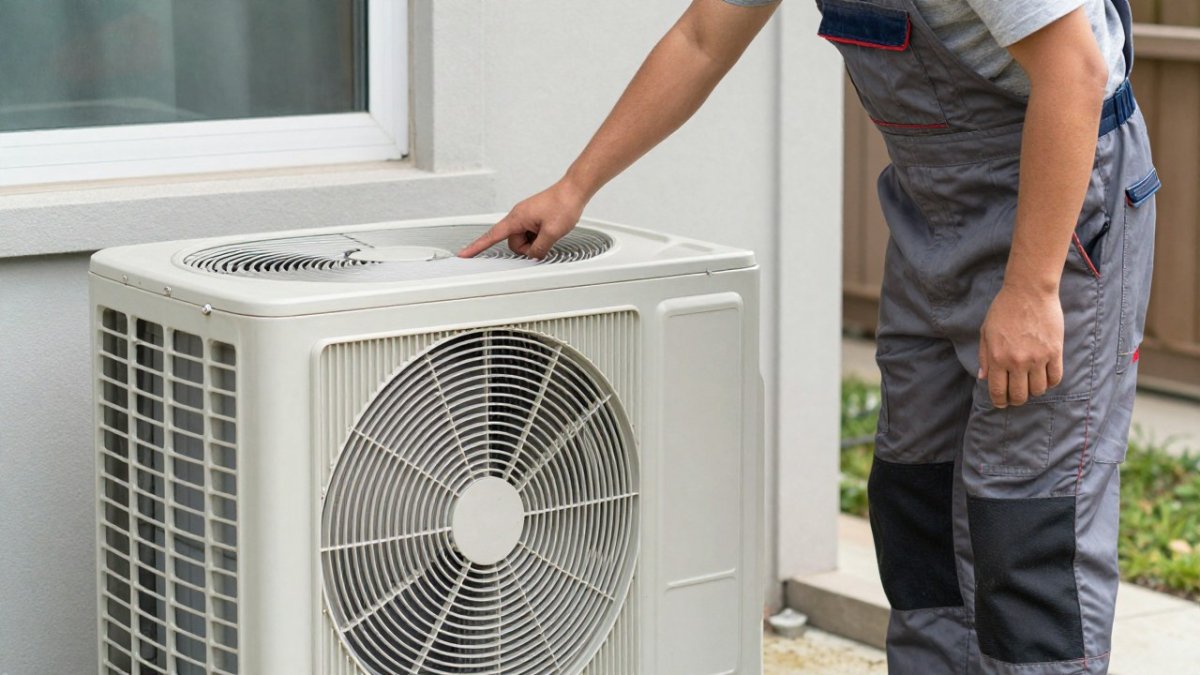
- Turn the system off at the thermostat. Set the mode to Off, not just a higher temperature. This stops the call for cooling while you work outside.
- Shut off power at the outdoor disconnect and the breaker. The disconnect is the small switch or pull-out block near the condenser; the breaker is in the home's electrical panel. Confirm the fan is not running before you proceed.
- Check the breaker and disconnect. If the breaker is tripped, reset it once. If it trips again immediately, stop: a breaker that will not hold points to a short or a failing component, and repeated resets can damage the compressor. Leave it off and call a technician.
- Clear debris from the outside. With power off, remove leaves, grass clippings, plastic bags, or anything resting against the fan grille. Do not reach through the grille into the blades.
- Turn the blade by hand with power off. A healthy fan turns freely with light finger pressure. If it is stiff, grinds, or wobbles, the motor bearings or the blade hub may be failing. If it spins freely but will not start on its own, a capacitor or motor winding problem becomes more likely.
- Look at the capacitor from outside the cover only. A bulged top, leaking fluid, or burn marks are visible without opening the electrical compartment. Do not remove a cover labeled with a high-voltage warning.
- Restore power and watch for a few seconds. If the fan starts, let it run and note whether it stays running or stops again. If it hums without turning, shut the system off at the thermostat and breaker immediately.
Watch out: A capacitor can hold a dangerous charge after the power is off, and the outdoor unit contains line voltage that can injure or kill. Do not discharge, test, or replace a capacitor, and do not probe wiring, unless you are trained and using the right meter.
What the symptoms tell you (without confirming a diagnosis):
- Fan hums but does not turn, then trips the breaker: suspect the capacitor or a seized motor; stop and call for service.
- Fan turns freely by hand but will not start on its own: capacitor is the most common cause, but a motor winding or control board fault can produce the same symptom.
- Fan does not turn and there is no hum: suspect power delivery, a tripped breaker, a bad contactor, or a control signal problem.
- Fan turns slowly or stops and restarts: a weak capacitor or a motor nearing the end of its life is common.
- Fan is blocked or rubbing: an obstruction or bent blade, which you can often see and clear safely with power off.
These patterns are guides, not proof. Only a technician with a meter can confirm which part has failed, and replacing the wrong part wastes money and leaves the real fault in place.
Work through these checks in order, and stop the moment anything looks or smells wrong.
| Step | What to do | Time or frequency |
|---|---|---|
| Turn system off at thermostat | Set mode to Off, not just a higher temperature | Before any work |
| Shut off power | Use outdoor disconnect and the breaker | Before any work |
| Check breaker | Reset once; if it trips again, stop and call a technician | Once |
| Clear debris | Remove leaves, clippings, bags from fan grille with power off | With power off |
| Turn blade by hand | Healthy fan turns freely with light finger pressure | With power off |
| Inspect capacitor | Look for bulging, leaking, or burn marks from outside the cover | Visual check only |
| Restore power and watch | Note whether fan stays running; if it hums without turning, shut off | A few seconds |
When an AC Condenser Fan Motor Replacement Makes Sense
Replacing the motor is worth considering when the motor has failed, is noisy, or has worn bearings, and the rest of the system is in good shape. The cost of a motor replacement depends on the motor type, the unit's age, and the parts available. A technician can test the motor and capacitor and tell you whether a repair or replacement makes the most sense for your equipment.
Booking a Diagnostic Visit With Giron & Son's
If the simple checks don't solve it, a diagnostic visit finds the actual cause before any part gets replaced. A technician can test the capacitor, check voltage and wiring, and confirm whether the motor is the problem. For current pricing or a quote, contact Giron & Son's Heating & Cooling through our website. You can book an appointment online for diagnostics.
Giron & Son's Heating & Cooling provides residential AC repair. If your fan keeps stopping, request AC repair service from our team and we can help with diagnostics.
Is your condenser fan still not spinning after the steps above? Our team at Giron & Son's Heating & Cooling can find the cause quickly and explain your options in plain terms. Schedule online today.
Frequently Asked Questions
Could a bad capacitor keep the condenser fan from spinning?
Yes. The run capacitor gives the condenser fan motor the extra electrical push it needs to start and keep turning. When it weakens or fails, the motor often hums, struggles to start, or does not turn at all while the compressor keeps running. Capacitors store electrical charge even when the power is off, so a capacitor should be tested and replaced only by someone trained to discharge it safely. A licensed HVAC technician can confirm the diagnosis and replace the part,
Why is my outdoor AC unit humming but the fan is not turning?
A humming sound with no rotation usually means the motor is receiving power but cannot start turning. The most common causes are a failed or weak run capacitor, a seized motor bearing, or a fan blade blocked by debris such as leaves or sticks. Turn the system off at the thermostat and at the disconnect switch before looking inside the unit. If the fan blade turns freely by hand, the capacitor is the more likely culprit. If it does not, the motor may need replacement, which should be handled by a technician.
Can I run my AC if the outdoor fan is not spinning?
It is best not to. With the condenser fan stopped, heat cannot leave the outdoor unit, so pressure and temperature rise inside the compressor. Running the system this way can cause the compressor to overheat and fail, which is one of the most expensive repairs an AC system can need. Shut the system off at the thermostat and schedule a diagnostic visit. Continuing to run the unit to see if the fan starts again can turn a fan repair into a compressor replacement.
When should I call an HVAC technician for a condenser fan problem?
Call a technician if the fan does not spin, hums without turning, or stops and starts, especially if the unit is running warm or the house is not cooling. Electrical work involving the capacitor, contactor, wiring, or motor should be left to a licensed professional. Homeowners can safely check for visible debris, confirm the breaker is on, and make sure the thermostat is calling for cooling. For help, you can contact Giron & Son's Heating & Cooling through the website.
