
Last Updated: October 26, 2026
Quick Summary
Your HVAC technician arrival time depends on urgency, season, and your place in the dispatch queue, so contractors give ranges rather than exact minutes. Life-safety emergencies often see arrival within 1 to 3 hours, while routine repairs typically get a firm window 1 to 3 days out. A good contractor promises a real window, a priority tier you understand, and a call when the tech is on the way.
- A 2025 FIELDBOSS survey found 29.8% of homeowners expect service within a few hours.
- No heat below freezing or no cooling for a vulnerable resident is often same day, within 2 to 6 hours.
- Same-day repair is realistic if you call in the morning and no special-order part is needed.
- An appointment window is a two-hour block, not a guarantee of an exact arrival minute.
- Ask the dispatcher what window they can hold and whether they will call when the tech is on the way.
Table of Contents
- What a Realistic HVAC Technician Arrival Time Looks Like
- Emergency HVAC Repair Response Time: What Counts as Urgent
- Same-Day HVAC Repair: When It's Possible and When It Isn't
- How Dispatch Prioritization Decides Your Place in Line
- What Your HVAC Service Appointment Window Really Means
- What to Do While Waiting for HVAC Repair
- How to Get a More Accurate ETA Before You Book
- Schedule Your Service Call With Giron & Son's Heating & Cooling
- Frequently Asked Questions
What a Realistic HVAC Technician Arrival Time Looks Like
A 2025 survey from FIELDBOSS's HVAC customer preferences research found that 29.8% of homeowners expect service within a few hours, which most contractors treat as same-day service.
The most useful answer separates calls by urgency instead of offering one vague estimate. Here are realistic ranges most contractors work within under normal conditions:
- Life-safety emergency (gas smell, carbon monoxide alarm, sparking or burning at the unit): treat as immediate. Dispatch should route you to the gas utility or fire department first if there is any suspicion of a leak or fire hazard, then send a technician as soon as one is free, often within 1 to 3 hours, but safety personnel come first.
- No heat below freezing or no cooling for a vulnerable resident (infant, elderly, medical need): often same day, frequently within 2 to 6 hours when called in the morning.
- Complete system failure in extreme weather with no vulnerable resident: same day is common if you call before noon; otherwise the next morning is realistic during peak season.
- No cooling or no heat in mild weather: same day to next day, depending on schedule load.
Two clarifications keep these ranges honest. First, arrival time is not repair completion time, reaching your door is the start of diagnosis, and a part that has to be ordered can add days. Second, these are typical ranges, not guarantees; a first heat wave or cold snap can push every tier back.
The honest answer is that nobody can promise an exact minute. What a good contractor can promise is a real window, a priority tier you understand, and a call when the tech is on the way.
Here are the realistic arrival ranges we work within under normal conditions, sorted by urgency.
| Situation | Typical arrival time | Note |
|---|---|---|
| Life-safety emergency (gas smell, CO alarm, sparking) | Often within 1 to 3 hours | Safety personnel come first |
| No heat below freezing or no cooling for vulnerable resident | Often within 2 to 6 hours | Same day when called in the morning |
| Complete system failure in extreme weather | Same day if before noon | Otherwise next morning in peak season |
| No cooling or no heat in mild weather | Same day to next day | Depends on schedule load |
| Routine repair (weak airflow, strange noise) | 1 to 3 days out | Firm appointment window |
| Preventive maintenance | Days to weeks ahead | Especially before a seasonal peak |
Emergency HVAC Repair Response Time: What Counts as Urgent
Emergency HVAC repair response time is the window between your call and a technician reaching your door when your system has failed in a way that threatens safety or property. For emergency furnace repair in Waterloo, IL, our team handles diagnostics, repair, and safety-first service.
Published estimates vary widely by company and conditions. Some contractors advertise 60 to 90 minutes for true emergencies under normal conditions, while others give a 4-to-24-hour range during a heat wave. Those are company-specific numbers, not an industry standard.
No Cooling in Summer vs No Heat in Winter
Summer and winter emergencies are not equal. A house with no cooling in a heat wave is uncomfortable, but a house with no heat in a hard freeze is a burst-pipe risk. We prioritize heat failures when temperatures drop below freezing, because water damage costs far more than a repair.
Same-Day HVAC Repair: When It's Possible and When It Isn't
Same-day HVAC repair is realistic when three things line up: you call in the morning, the fix needs no special-order part, and the schedule has an open slot. It falls apart when the diagnosis points to a compressor or a control board that has to be ordered.
What raises your odds of same-day service:
- Call before noon, not at 5 p.m.
- Describe the symptom clearly, not just "it's broken"
- Have your system's age and model ready
- Accept the first available window
What kills it: peak-season call volume, after-hours requests for non-urgent issues, and long travel distance to rural addresses.
How Dispatch Prioritization Decides Your Place in Line
Dispatch prioritization is how a contractor ranks incoming calls, and it is the single biggest factor most homeowners never see. A dispatcher weighs safety risk, system type, parts on hand, technician availability, and travel distance before assigning a slot.
Here is how we rank a typical day:
- No heat below freezing or no cooling for a vulnerable resident (elderly, infant, medical need)
- Complete system failure in extreme weather
- Partial failure with the home still livable
- Routine maintenance and tune-ups
A call volume spike during the first heat wave of summer can push a routine call back a day. That is not favoritism. It is triage.
What Your HVAC Service Appointment Window Really Means
An HVAC service appointment window is a two-hour block when a technician is scheduled to reach your home, not a guarantee of that exact minute. A "10 a.m. to noon" window means the tech should arrive inside that block, barring a delayed prior job.
What the window does not cover:
- Arrival time vs repair completion time. Arriving at 11 a.m. does not mean the repair is done by noon. Diagnosis, parts, and the fix all take time after arrival.
- Traffic and weather. A two-hour window absorbs most of it, but not all.
- Prior-job overruns. One tough repair can push the whole afternoon back.
Ask about the cancellation policy when you book. A good shop will tell you plainly.
What to Do While Waiting for HVAC Repair
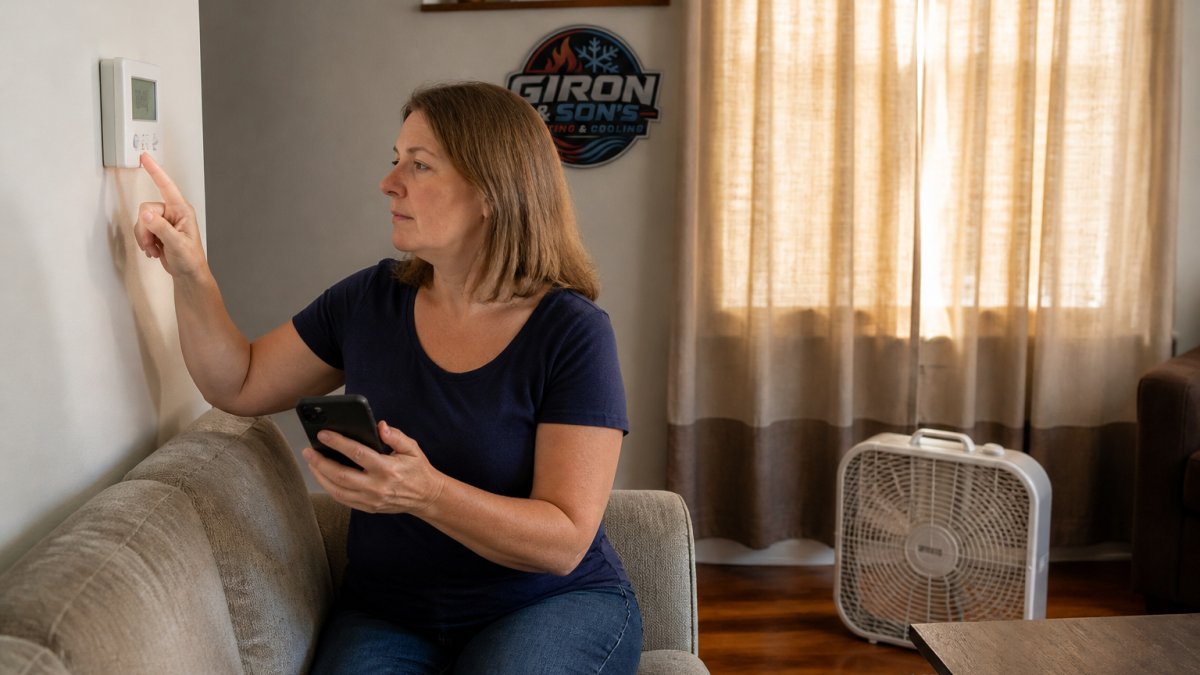
While waiting for HVAC repair, your job is to keep the household safe and make the technician's visit fast. The right steps depend on why the system failed, so match your situation to the scenario below rather than following one generic checklist.
If You Smell Gas or the Carbon Monoxide Alarm Sounds
This is a life-safety emergency, not a repair appointment. Leave the home, do not flip switches or use your phone inside, and call 911 and your gas utility from outside. Do not wait for an HVAC technician to arrive before acting. Once the utility clears the home, a technician can address the equipment.
If You See Sparking, Smell Burning, or Notice Scorched Wiring
Turn the system off at the thermostat and, if it is safe to reach, at the breaker. Do not reset the breaker repeatedly. Keep people away from the unit and tell the dispatcher exactly what you saw so the call is triaged as an electrical hazard.
If the Home Is Dangerously Hot or Cold
- Extreme heat: move vulnerable household members to the lowest floor or a shaded room, use fans, close curtains against direct sun, hydrate, and consider a cooling center if indoor temperatures climb. Never run a generator or charcoal grill indoors (the CDC).
- Extreme cold: consolidate the household into one room, use safe space heating with clearance from combustibles, let faucets drip to reduce freeze risk, and know where your water shutoff is. Never use an oven or stovetop as a heat source.
- Vulnerable residents: infants, older adults, and people with medical conditions can deteriorate faster than the rest of the household; if their comfort or safety is at risk, say so when you call so dispatch can prioritize.
Practical Steps That Help Any Visit
- Turn the system off at the thermostat if you smell burning or hear grinding
- Check the air filter; a clogged filter mimics a breakdown
- Confirm the breaker for the unit is not tripped
- Clear 3 feet of space around the indoor and outdoor units
- Write down the symptom, when it started, and any error code
If the AC is running but the house stays warm, run through the simple checks homeowners can do before calling for repair. You may solve it in five minutes, and if not, you will have better information for the technician.
How to Get a More Accurate ETA Before You Book
The most accurate ETA comes from a dispatcher who knows the day's load, not from a website widget. Call, describe the problem, and ask two questions: what window can you hold, and will you call when the tech is on the way.
What sharpens the estimate:
- Book online for routine work. Our online scheduling shows open windows so you pick a slot that fits your day.
- Ask about the diagnostic fee upfront. Know the cost before you commit. Here is what a residential HVAC diagnostic typically runs.
- Share your address and system age. Travel distance and equipment type change the estimate.
- Request the call-ahead. A 30-minute heads-up lets you get home.
Watch out: a rock-bottom ETA quote with no window is a sales tactic, not a schedule. Ask for the window in writing.
Schedule Your Service Call With Giron & Son's Heating & Cooling
Getting a straight answer about arrival time should not be hard. We are veteran-owned, and we run on clear communication and solid diagnostics, not runaround. When you call, you get a real window and a call when the tech is on the way.
Here is what you can count on:
- Clear appointment windows with a heads-up call before arrival
- Solid diagnostics so the fix is right the first time
- Online scheduling that fits around your workday
Get started with Giron & Son's Heating & Cooling and book a service window you can actually plan around.
Frequently Asked Questions
How quickly can an HVAC technician arrive for an emergency?
It depends on urgency, location, and how full the dispatch board is. A 2025 FIELDBOSS survey found 29.8% of respondents expected service within a few hours, which contractors describe as same-day service. Some companies quote 60 to 90 minutes for true emergencies in their core service area under normal conditions, while others give a 4-to-24-hour range during a heat wave. Ask for a specific arrival window when you call, and confirm whether after-hours service carries extra charges.
Do HVAC companies offer same-day HVAC repair?
Many do, but same-day HVAC repair is easier to get for urgent situations like no cooling in summer or no heat in winter than for routine maintenance. Call volume, technician availability, and travel distance all affect whether you land a slot. Booking early in the day improves your odds, since afternoon slots fill first. If your system is down and you need it back today, say so clearly when you schedule and ask what the realistic arrival window looks like.
What should I do while waiting for an HVAC technician?
Shut the system off at the thermostat to avoid straining a failing component, and clear a path to the indoor unit and outdoor condenser. Note when the problem started and any sounds, smells, or error codes you noticed, since that speeds up diagnosis. In extreme heat, move to the coolest room, hydrate, and check on older neighbors. In cold weather, layer up and keep cabinet doors open on exterior walls so pipes stay warmer.
Does an HVAC service appointment window mean the technician arrives at that exact time?
No. An HVAC service appointment window is a range, usually two hours, not a fixed arrival time. Technicians often call ahead when they are on the way, which gives you a tighter estimate. Earlier calls in the day tend to run closer to schedule, while later appointments can slide if earlier jobs uncover bigger repairs. If you need to leave for work, ask whether the dispatcher can text you an updated ETA before the window opens.
